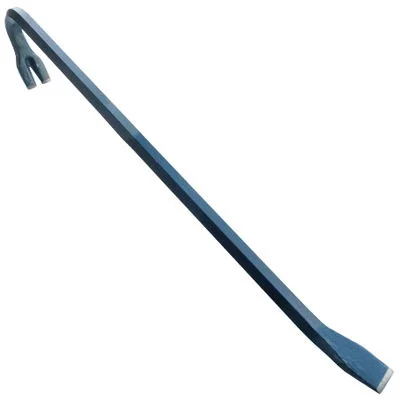
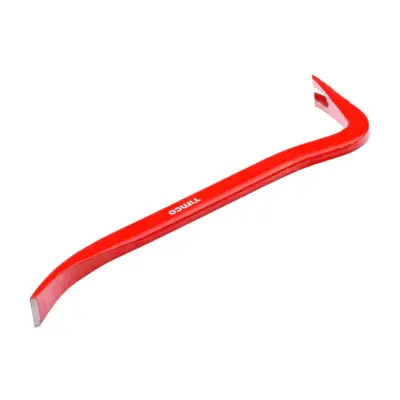
Traditional hexagonal-section gooseneck wrecking bar, forged from high carbon steel and hardened for lasting strength. Chisel end and claw nail-puller on opposing ends. Available in six sizes from 300mm to 900mm. A solid workhorse for breaking, levering and nail pulling.
Size
Price
QTY
20inch 500mm
£4.95£5.94
24inch 600mm
£5.11£6.13
30inch 750mm
£8.60£10.32
36inch 900mm
£9.30£11.16
A wrecking bar is one of those tools that earns its place in the van on day one and never really leaves. This is a traditional gooseneck design with a hexagonal cross-section, forged from high carbon steel and hardened and tempered throughout. One end has a flat chisel tip for getting under boards, prying apart joints, and opening up old timber work. The other end carries a claw, which makes short work of pulling nails without reaching for a separate tool. Simple concept. Proven design. It works.
The hexagonal section gives you something a round bar cannot: it does not roll off scaffolding, out of the back of a van, or across a sloping floor. Small thing, but you notice it after the third time a round bar disappears under a skip. The forged construction means the bar flexes rather than snapping under hard lever loads, which matters when you are pulling old structural fixings or prising apart timber that has been in place for thirty years.
What Sizes Are Available
Six lengths cover most applications: 300mm, 450mm, 500mm, 600mm, 750mm and 900mm. The shorter bars are handy in tight spaces, working inside stud walls, or pulling fixings where swing room is limited. The longer bars give you serious leverage for breaking up floorboards, demolishing stud partitions, and shifting heavy framing timber. If you regularly strip out kitchens or bathrooms, having a short and a long bar in the tool bag is not excessive. There is a reason most experienced tradespeople own more than one length.
Who Uses Wrecking Bars
Builders and joiners reach for them most often, but this wrecking bar turns up regularly in plumber and electrician kits too, for chasing out fixings or opening access panels. Warehouse operatives use them constantly for breaking down wooden crates and pallet collars. Once you have one, you find uses for it most days.
Available individually in the size that suits the job at hand.
Pro Tip: When levering up old floorboards, place a scrap piece of timber under the bar as a fulcrum closer to the nail rather than working from the edge, you will get cleaner lifts with far less splitting.
Wrecking bars like these are used daily on strip-out and demolition work, pulling nails from reclaimed timber, levering up floorboards, breaking apart stud partitions, and dismantling joinery. Electricians and plumbers reach for them when shifting fixed cable runs or forcing open access areas that were never meant to be opened again. In warehouse and logistics environments they are the standard tool for breaking down nailed timber crates, pallet boxes and wooden packaging. Basically, if something is nailed together and needs to come apart, a wrecking bar is usually the quickest way to start.
Best For
Strip-out and demolition work
Levering up floorboards
Pulling nails from timber
Dismantling stud partitions and joinery
Opening wooden crates and pallet boxes
General site levering and prying
Available In
12 inch / 300mm
18 inch / 450mm
20 inch / 500mm
24 inch / 600mm
30 inch / 750mm
36 inch / 900mm
Key Features
Forged high carbon steel construction
Hardened and tempered for strength
Hexagonal section, does not roll
Gooseneck profile for controlled leverage
Chisel end for prying and splitting
Claw end for nail pulling
Not suitable for: Not intended for use as a striking tool or hammer. Not suitable for pulling fixings from masonry or concrete without appropriate support at the fulcrum point.
Choose the bar length that suits the job: shorter bars for confined spaces and precision nail pulling, longer bars where you need maximum lever force on heavy framing or old structural timber. Position the chisel end under the material you are prying, keeping a scrap timber block close by to use as a fulcrum if working on finished surfaces you want to protect. Apply steady lever pressure rather than sharp force, the forged steel will do the work.
For nail pulling, hook the claw around the nail shank as close to the surface as possible. A short, controlled pull usually draws the nail cleanly without tearing the surrounding timber. On long nails, work in stages, pulling until the nail bends slightly, then repositioning the claw for a fresh pull.
Select the appropriate bar length for the task and the available working space
For prying, insert the chisel end into the joint or gap and position a timber offcut under the bar as a fulcrum to protect the work surface
Apply steady downward lever pressure, repositioning the fulcrum closer to the fixing point if extra force is needed
For nail pulling, hook the claw end around the nail shank as close to the timber surface as possible
Pull the bar in a controlled arc to draw the nail, working in stages on long or deep nails rather than forcing in one movement
Keep the bar clean and lightly oiled on the working ends to prevent surface rust during storage
What is the difference between a short and a long wrecking bar?
Length determines leverage. A 300mm bar gives you control and precision in tight spots, ideal for pulling nails or working inside stud walls. A 900mm bar generates serious lever force for shifting heavy floorboards, breaking apart old framing, or prying apart sections that have been fixed for decades. Many tradespeople keep both sizes.
Why does this bar have a hexagonal section rather than round?
A hexagonal section stops the bar rolling when you set it down on a sloping surface or scaffolding board. It also gives a more positive grip in the hand under heavy lever loads. Round bars are cheaper to produce but the hexagonal section is the traditional professional standard for good reason.
Can this wrecking bar be used on masonry or concrete?
Not really. This bar is designed for timber work, nail pulling, and general joinery strip-out. For breaking into masonry or concrete you would need a cold chisel and hammer, or a breaker. Using a wrecking bar on hard masonry risks damaging the chisel tip and will not be particularly effective anyway.
Forged from high carbon steel and hardened and tempered after forming, these bars offer reliable strength under sustained lever loads without becoming brittle. The gooseneck profile is a traditional design that positions the working ends at opposing angles, giving clearance for both prying and nail pulling without repositioning your grip. The hexagonal cross-section is a standard professional format in the UK market. No coatings or plating are listed, so a light wipe of oil on the working ends during storage will prevent surface rust.

Reviews
There are no reviews yet.