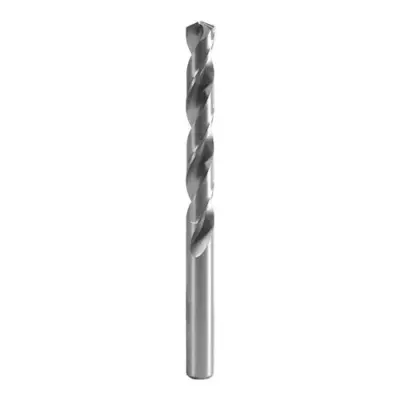
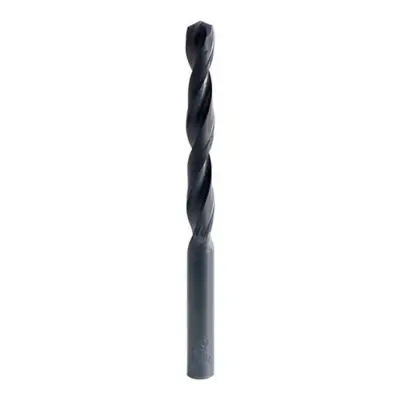
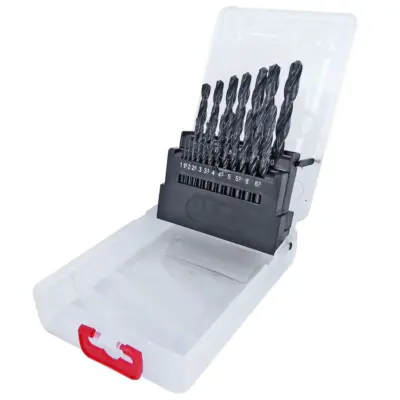
M2 HSS ground jobber drill bit with 135-degree split point tip from 3mm upwards. Black oxide finish, roll forged to DIN338. Available in a wide range of metric and imperial sizes for general drilling in non-alloy materials.
Can’t find it? We’ll source it.
No worries! We can usually get this in for next-day delivery or source an alternative. Drop your email and we’ll get straight back to you with options.
Nice one — request received. Check your email to confirm, and we’ll get pricing and availability over to you.
Size
QTY
Price
QTY
1/32"
10
£4.48£5.38
7/64"
10
£4.52£5.42
1/16"
10
£3.94£4.73
5/64"
10
£4.39£5.27
3/32"
10
£3.52£4.22
1/8"
10
£3.90£4.68
9/64"
10
£4.84£5.81
3/16"
10
£5.86£7.03
5/32"
10
£4.60£5.52
7/32"
10
£6.96£8.35
13/64"
10
£7.50£9.00
1/4"
10
£8.75£10.50
5/16"
5
£7.15£8.58
21/64"
5
£8.67£10.40
3/8"
5
£9.40£11.28
1/2"
5
£18.73£22.48
1.0mm
10
£5.16£6.19
1.5mm
10
£3.79£4.55
2.0mm
10
£3.87£4.64
2.4mm
10
£3.88£4.66
2.5mm
10
£3.89£4.67
3.0mm
10
£4.19£5.03
3.1mm
10
£4.48£5.38
3.2mm
10
£4.48£5.38
3.3mm
10
£4.48£5.38
3.5mm
10
£4.53£5.44
3.6mm
10
£4.96£5.95
3.8mm
10
£4.96£5.95
4.0mm
10
£4.96£5.95
4.1mm
10
£4.96£5.95
4.2mm
10
£5.02£6.02
4.5mm
10
£5.08£6.10
4.8mm
10
£6.58£7.90
4.9mm
10
£6.69£8.03
5.0mm
10
£6.17£7.40
5.1mm
10
£7.14£8.57
5.3mm
10
£7.47£8.96
5.5mm
10
£8.13£9.76
6.0mm
10
£8.54£10.25
6.4mm
10
£9.38£11.26
6.5mm
10
£9.11£10.93
6.8mm
10
£10.35£12.42
7.0mm
10
£10.34£12.41
7.5mm
5
£6.03£7.24
8.0mm
5
£7.01£8.41
8.5mm
5
£7.73£9.28
9.0mm
5
£8.77£10.52
9.5mm
5
£9.77£11.72
10.0mm
5
£10.97£13.16
10.2mm
5
£13.14£15.77
10.5mm
5
£12.24£14.69
11.0mm
5
£13.92£16.70
11.5mm
5
£15.16£18.19
12.0mm
5
£16.35£19.62
12.5mm
5
£18.19£21.83
13.0mm
5
£19.87£23.84
2.0mm
1
£0.50£0.60
2.5mm
1
£0.53£0.64
3.0mm
1
£0.65£0.78
3.5mm
1
£0.74£0.89
4.0mm
1
£0.75£0.90
4.5mm
1
£0.83£1.00
5.0mm
1
£1.00£1.20
5.5mm
1
£1.14£1.37
6.0mm
1
£1.23£1.48
6.5mm
1
£1.28£1.54
7.0mm
1
£1.49£1.79
8.0mm
1
£1.80£2.16
8.5mm
1
£1.96£2.35
9.0mm
1
£2.22£2.66
10.0mm
1
£2.79£3.35
11.0mm
1
£3.19£3.83
12.0mm
1
£3.89£4.67
13.0mm
1
£4.57£5.48
The HSS ground jobber drill bit is one of those tools that sits quietly in every tradesperson’s kit, doing the work without any fuss. This M2 grade bit is ground to a 135-degree split point from 3mm and above, which means no centre punching, no wandering, and no pre-drilling faff. Line it up, pull the trigger, and it goes where you put it. That matters when you’re drilling twenty holes in a morning rather than two.
Black oxide finish helps with heat resistance and gives a degree of corrosion protection during storage and use. The bits are roll forged and manufactured to DIN338, which is the standard specification for jobber-length twist drills — so you know what you’re getting in terms of length-to-diameter ratio and overall geometry. Nothing exotic, just a solid, properly made bit that performs consistently across the size range.
Where the HSS Ground Jobber Drill Bit Earns Its Keep
This is a general-purpose drill bit for non-alloy materials: mild steel, aluminium, brass, copper, timber, sheet materials and most plastics. It handles the day-to-day without complaint. The split point geometry is particularly useful when drilling curved or sloped surfaces where a standard 118-degree tip would skate about until it finally bites. From 3mm upward, it self-centres on contact.
Available in both metric and imperial sizes, which is more useful than it sounds. Plenty of jobs still call for fractional imperial sizing, particularly when working to older specifications or matching clearance holes to imperial-threaded fixings. Having both systems available from a single product range avoids the need to keep two separate sets on the van.
Build Quality and Material Grade
M2 is the standard high-speed steel grade for general workshop and site use. It holds a good edge under normal working temperatures and is tough enough for intermittent use without snapping under side load. Ground bits produce a cleaner hole than rolled-only alternatives, which matters when tolerance is tight or surface finish counts. These are not cobalt bits and are not intended for hardened steels or stainless, but for the vast majority of drilling tasks on a typical job, they do exactly what’s needed.
Pro Tip: When drilling mild steel, keep your speed down and let the bit do the work at a steady feed pressure — pushing too hard generates heat that dulls the edge fast, and spinning too fast on larger diameters does the same.
Used across construction, fabrication, engineering, joinery and general site work for drilling clearance and pilot holes in mild steel, aluminium, brass, copper, timber, MDF, plywood and most plastics. The split point tip makes it well suited to sheet metal work where accurate hole placement matters. Also commonly used for drilling out rivets, creating cable entry points, and sizing holes prior to tapping.
Best For
Mild steel drilling
Aluminium and non-ferrous metals
Timber and sheet materials
Plastics
Pilot holes and clearance holes
Sheet metal work
Works With
Standard pillar drills
Cordless and corded hand drills
Bench-mounted drilling machines
Drill press chucks up to 13mm
Key Specifications
Grade: M2 HSS
Tip angle: 135-degree split point (3mm and above)
Finish: Black oxide
Manufacture: Roll forged
Standard: DIN338
Sizes: Metric and imperial available
Not suitable for: Not suitable for hardened steels, stainless steel, or cast iron. Not designed for masonry, concrete or ceramic materials.
Select the correct size for your application and secure the bit firmly in the chuck. For metric pilot holes ahead of tapping, use a standard tapping drill size chart to choose the right diameter. Ensure the workpiece is clamped or secured before drilling.
From 3mm upward, the split point will self-centre without a punch mark, but on curved or polished surfaces a light centre pop still helps on the first contact. Apply a drop of cutting fluid when drilling steel, particularly on larger diameters. Keep feed pressure steady and consistent rather than forcing the bit through.
Select the correct drill size for your application, checking against a tapping chart if drilling for a thread
Secure the bit in the chuck and tighten fully using the key or collar
Clamp the workpiece securely before starting
For curved or polished surfaces, use a centre punch to create a starting point
Apply cutting fluid to the tip when drilling ferrous metals
Set an appropriate drill speed for the material and diameter — lower speed for larger bits and harder metals
Apply steady, even feed pressure throughout the cut
Back the bit out occasionally on deeper holes to clear swarf and reduce heat build-up
What is the difference between a ground drill bit and a standard rolled HSS bit?
Ground bits are finished by precision grinding after forming, which produces a more accurate geometry and a sharper cutting edge than a rolled-only bit. The result is a cleaner hole, better accuracy and generally longer edge life under normal use.
Do I need to centre punch before using the split point tip?
On flat surfaces, no. From 3mm upward the 135-degree split point self-centres on contact, which removes the need to pre-punch or pre-drill a pilot hole. On curved, sloped or polished surfaces a light centre punch still helps prevent any initial skating.
Are these suitable for drilling stainless steel?
These are M2 HSS bits, which are not recommended for stainless steel. Stainless work-hardens quickly and requires cobalt-grade bits (M35 or M42) with the right technique and cutting fluid to avoid work-hardening the material and destroying the edge.
Manufactured from M2 high-speed steel, roll forged and ground to DIN338 jobber-length specification. The black oxide surface treatment provides modest corrosion resistance and reduces friction slightly during cutting. The 135-degree split point geometry (applied from 3mm upward) reduces thrust force and improves self-centring compared to a conventional 118-degree tip. M2 steel offers a good balance of hardness and toughness for general-purpose drilling at normal working temperatures.

Reviews
There are no reviews yet.