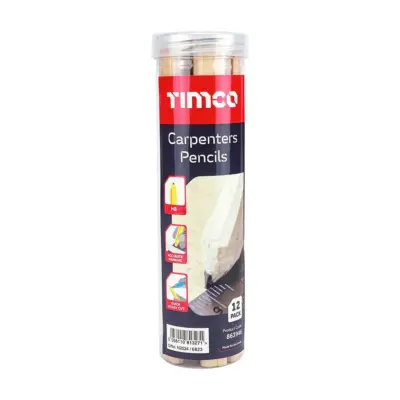
A pack of 12 carpenters pencils at 180mm long. Flat rectangular shape stops them rolling off surfaces, and the broad HB lead is built for marking timber, masonry, and other rough materials on site.
Carpenters pencils are one of those things that sounds simple until you’ve lost three round pencils down a roof slope in the same morning. The flat, rectangular body on these is there for a reason — it stays put on angled surfaces, workbenches, and scaffold boards without rolling off the edge. Small detail, genuine time saver. At 180mm long, they sit comfortably in a tool belt or apron pocket without the pointy end trying to stab you every time you crouch down.
The lead is a broad HB, which gives you a mark that’s actually visible on rough timber, concrete, brick, and most other surfaces you’re likely to encounter on a working site. Fine art pencils this is not. The wider lead profile means your line stays legible even on sawn or rough-sawn timber faces where a thin line would disappear into the grain. It also holds up better against the kind of casual abuse a pencil gets in a tool bag.
Why Carpenters Pencils Work Better on Site
A standard round pencil snaps under pressure, rolls away constantly, and leaves a mark you can barely see on anything textured. Carpenters pencils solve all three problems at once. The flat body gives you control when you’re scribing against a straight edge or marking a cut line across a joist. The broad lead means the mark is bold enough to follow with a saw. And sharpening one with a knife or chisel takes seconds — there’s no fiddling with a pencil sharpener that wasn’t designed for a flat barrel.
Twelve in a pack makes sense for any tradesperson or site team. They go missing, they get borrowed, they get dropped into the gap between the joists. Having a decent supply on hand means you’re not hunting for a pencil when you need to mark a cut. Keep a few in your bag, a few in the van, job done.
Pro Tip: Sharpen carpenters pencils with a sharp knife or chisel blade rather than a standard sharpener — cut the wood casing back first, then shape the lead to a flat chisel edge for crisp, consistent marking lines on timber.
Carpenters pencils are used day to day by joiners, carpenters, roofers, bricklayers, and general builders for marking cut lines, setting out measurements, and scribing timber to profile. They work well on sawn and rough-sawn timber, concrete blocks, plasterboard, and brick faces. Any trade that involves cutting material to length or marking positions will find these useful. They're equally at home in a joinery workshop as they are on a construction site in January.
Best For
Marking cut lines on timber
Setting out on rough masonry
Scribing to profile
General site marking
Workshop use
Works With
Sawn and rough-sawn timber
Planed timber
Concrete and blockwork
Plasterboard
Brick and stonework
Key Features
180mm length
Flat rectangular body — won't roll
Broad HB lead
Pack of 12
Sharpenable with a knife or chisel
Not suitable for: Not suitable for fine detail drawing or use in standard round pencil sharpeners. Not intended for use on smooth finished surfaces where a finer line is needed.
Sharpen the pencil using a sharp knife or chisel — remove the wood casing from one side first, then shape the lead to the angle you need. For cut lines on timber, hold the pencil flat against a square or straight edge and draw in one clean pass. Press firmly enough to leave a clear mark but don't drag the lead sideways or it will snap.
Sharpen the pencil with a sharp knife by paring back the wooden casing on the flat face, then shaping the lead to a point or chisel edge
Hold the pencil at a consistent angle against your square, rule, or straight edge
Draw the mark in a single confident stroke rather than multiple light passes
For scribing to a profile, keep the pencil body flat against the reference surface and move steadily along the line
Store unused pencils in a dry location — the lead can absorb moisture and become crumbly if left in wet conditions for extended periods
What lead grade are these carpenters pencils?
These pencils use a hard HB lead. It's a practical choice for site use — firm enough to hold a usable edge after sharpening, and dark enough to leave a clear mark on timber and masonry without smudging too badly when you run your hand across the surface.
How do you sharpen a carpenters pencil?
Use a sharp knife or a chisel blade. Hold the pencil flat, pare back the wooden body from one side, then shape the exposed lead to a chisel or point. Some carpenters keep a spare Stanley knife blade in their apron just for this. A standard pencil sharpener won't work on the flat barrel.
Why are carpenters pencils flat instead of round?
The flat rectangular body stops the pencil rolling off inclined surfaces like roof decks, angled workbenches, and scaffold boards. It also makes them easier to grip when you're wearing gloves or working with dusty hands. The wider body is simply more practical on site than a standard pencil.
These carpenters pencils measure 180mm in length with a flat rectangular profile and a broad HB graphite lead. The rectangular barrel is made from wood with the lead running centrally through the flat axis. HB denotes a medium-hard lead that balances marking visibility with reasonable durability, making it a standard choice for site marking applications across timber, masonry, and board materials.
Length
180mm
Lead Grade
HB
Barrel Shape
Flat rectangular
Pack Quantity
12
Suitable For
Timber, masonry, plasterboard, blockwork
Reviews
There are no reviews yet.
Be the first to review “Carpenters Pencils 180mm – 12 pack”Cancel Reply

Reviews
There are no reviews yet.