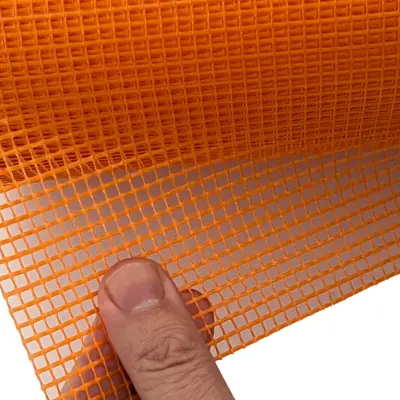
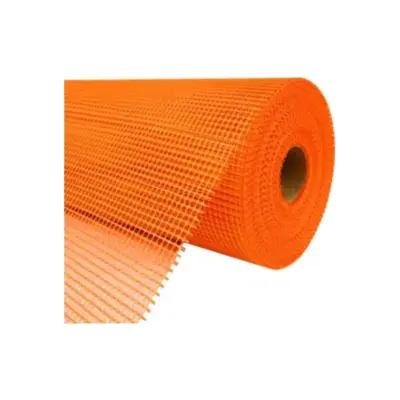
Premium fibreglass render mesh in high-visibility orange. 160gsm with a 4×4 grid, alkali resistant and lightweight. Reinforces renders, plasters, screeds and cement on both interior and exterior surfaces. Ideal for stabilising uneven or cracked masonry substrates before rendering.
Size
Price
QTY
1m x 50m (qty:1)
£31.95£38.34
1m x 50m (qty:6)
£167.70£201.24
1m x 50m (qty:10)
£275.00£330.00
This premium orange render mesh is a fibreglass reinforcement cloth designed to strengthen render, plaster and cement-based coatings across a wide range of substrates. At 160gsm with a 4x4mm grid pattern, it gives enough body to properly bed into the base coat while remaining light and easy to handle on site. Whether you’re working over a dodgy old masonry wall or laying fresh render on a new build, getting the mesh right is the difference between a finish that lasts and one you’re patching six months later.
The orange render mesh is alkali resistant, which matters more than it sounds. Cement and lime-based renders are highly alkaline environments, and standard glass fibre will degrade quickly if it isn’t treated to cope with it. This mesh holds up in those conditions, maintaining its structural contribution to the render coat rather than slowly dissolving inside it. It’s also tear resistant and flexible enough to work around corners and angles without becoming a fight.
Where Orange Render Mesh Makes the Difference
One of the most common uses is over surfaces that have already shown cracking. A cracked substrate doesn’t mean you can’t render over it cleanly, but going in without reinforcement is asking for the same problem to reappear. Bedding this orange render mesh into the scratch coat bridges those cracks and distributes movement across a wider area, which dramatically reduces the chance of reflective cracking coming through the finish coat. It’s also widely used where two different materials meet, such as a blockwork wall with a steel lintel, or a timber frame panel next to masonry, where differential movement is almost guaranteed.
The 4×4 grid gives a good balance between open area for the render to key through and enough strand density to provide real reinforcement. It’s not decorative. The mesh needs to be fully embedded, not sitting on the surface. The high-visibility orange colour actually helps here since you can clearly see coverage and make sure nothing has been missed before the next coat goes on.
A Note on the Roll Size
At 1m wide and 50m long, this roll covers a reasonable area on most jobs. For larger contracts or when running multiple crews, the bulk buy options at 6 or 10 rolls bring the unit cost down further. Fibreglass render mesh stores well as long as it stays dry and isn’t left somewhere it will get crushed or kinked on the roll.
Pro Tip: Always embed the mesh into the first coat while it is still wet and plastic, pressing it in with a steel float rather than just laying it on top. If it sits proud of the surface at all, it will print through to the finish coat.
Orange render mesh is used primarily by plasterers and renderers working on exterior wall systems, though it sees regular use on internal surfaces too. It is particularly well suited to EWI (external wall insulation) base coat systems, sand and cement renders, lime renders and monocouche applications. Anywhere there is a risk of cracking from substrate movement, thermal expansion or differential settlement, mesh reinforcement is standard practice.
It is commonly applied across joins between dissimilar materials, around window and door openings where stress concentrations are highest, and over entire wall faces where the substrate is uneven or has a history of cracking. Groundworkers also use it in some screed and slab reinforcement applications where a lightweight, non-metallic option is preferred.
Best For
Exterior sand and cement render
Lime render systems
EWI base coat reinforcement
Cracked or uneven masonry substrates
Around window and door openings
Joins between dissimilar materials
Compatible Surfaces
Blockwork and brickwork
Concrete
EPS and mineral wool insulation boards
Timber frame panels
Mixed substrate walls
Internal plaster backgrounds
Key Properties
160gsm fibreglass construction
4x4mm grid pattern
Alkali resistant
Tear resistant
Lightweight and flexible
High-visibility orange colour
1m x 50m per roll
Not suitable for: Not intended as a standalone structural reinforcement for load-bearing applications. Not suitable for use without being fully embedded in a compatible render or base coat.
Cut the mesh to length using scissors or a knife before you start, and plan your strips so overlaps fall in a sensible place. Overlaps should be at least 100mm to maintain continuity of reinforcement. Apply your scratch or base coat, then press the mesh firmly into the wet material using a steel float, working from the centre outward to avoid trapping air or creases.
Make sure the mesh is fully embedded and not sitting on the surface. Once it is in, allow the base coat to firm up before applying subsequent coats. Around corners and openings, cut and fold the mesh neatly rather than relying on it to stretch into position.
Cut mesh strips to length before starting, allowing at least 100mm overlap at all joints
Pre-cut any corner pieces or shaped sections for openings and reveals
Apply the base coat or scratch coat to the substrate at the correct thickness
While the coat is still wet, press the mesh firmly into the surface using a steel float
Work from the centre of each strip outward to remove air pockets and avoid creasing
Check the mesh is fully embedded with no proud edges or dry areas visible
Allow the base coat to firm sufficiently before applying the next coat
At joints between strips, ensure minimum 100mm overlap and embed both layers fully
Does the orange render mesh need to be embedded in a specific type of render?
It is compatible with most cement-based, lime-based and polymer-modified render systems. The key requirement is that it is pressed into the base coat while it is still wet, so it bonds fully into the matrix. Always check that your render system is suitable for mesh reinforcement if you are following a manufacturer's specification.
How much overlap is needed between strips of render mesh?
A minimum of 100mm overlap between adjacent strips is standard practice. This ensures there is no weak join in the reinforcement layer. At corners and angles, fold or cut the mesh neatly rather than relying on the overlap alone to cover the detail.
Manufactured from fibreglass yarns woven into a 4x4mm open grid and treated for alkali resistance, this render mesh has a weight of 160gsm. The alkali treatment is essential for long-term performance in cementitious environments, where untreated glass fibre would degrade and lose tensile strength over time. The orange colour is consistent through the product and aids visual inspection during installation.
Material
Alkali resistant fibreglass
Weight
160gsm
Grid pattern
4x4mm
Roll size
1m x 50m
Colour
Orange
Alkali resistant
Yes
Tear resistant
Yes
Size
1m x 50m (qty:1), 1m x 50m (qty:10), 1m x 50m (qty:6)
Reviews
There are no reviews yet.
Be the first to review “PREMIUM ORANGE Render Mesh – 1m x 50m”Cancel Reply

Reviews
There are no reviews yet.