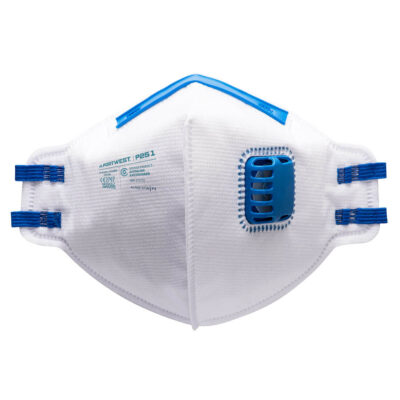
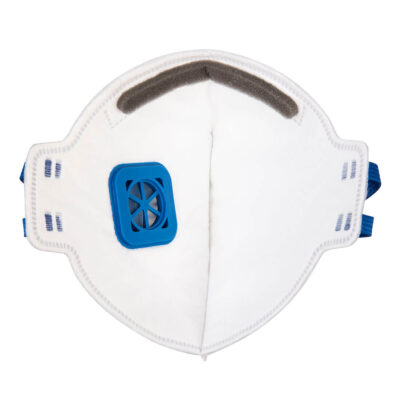
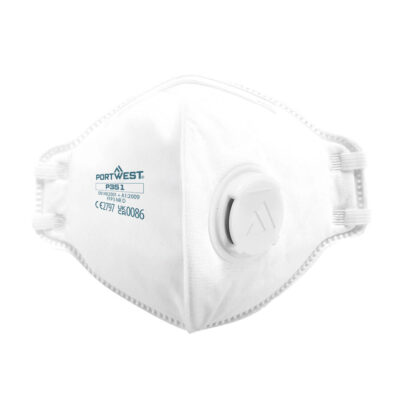
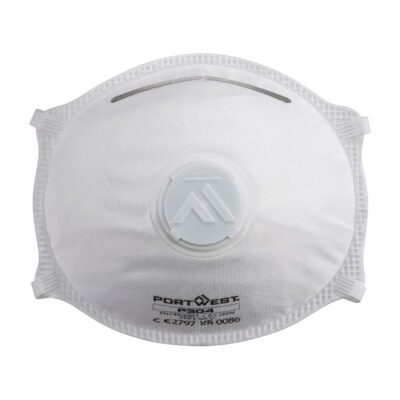
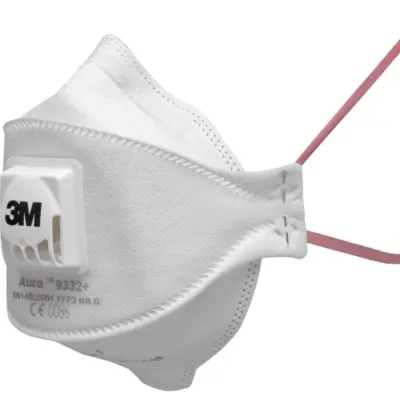
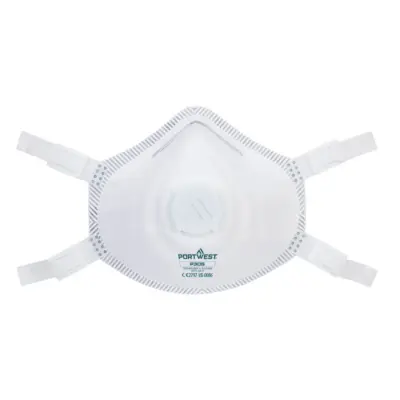
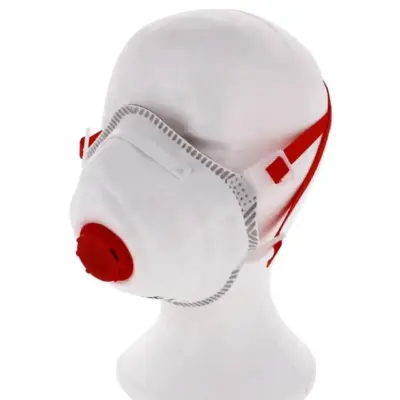
Portwest P251 FFP2 valved fold flat respirator mask. Individually wrapped, CE Cat III certified, with an exhalation valve, foam nose padding and ultrasonic welded head straps. Compact design fits neatly in a pocket or vending machine.
Trade QTY discounts — the more you buy, the more you save
Quantity
Discount
You Save
Price/unit
Buy 20+
£0.10£0.12
16.9% off
£0.49£0.59
Discount applies across all variants of this product.
The Portwest P251 FFP2 valved mask is a well-thought-out bit of PPE that actually gets used rather than sitting in a van glove box. FFP2 filtration covers a broad range of dust, mist and aerosol hazards, and the exhalation valve makes a real difference on longer wear — less heat build-up, lighter breathing resistance, and you’re less likely to rip it off after twenty minutes because your face feels like it’s in a sauna.
The fold-flat design is the practical bit. It packs down small enough to slip into a pocket, sit in a tool belt pouch, or load into a site vending machine. Each mask comes individually sealed in its own polybag, which keeps it clean and ready to use. That matters more than it sounds — a mask that’s been rattling around loose in a box with plasterboard dust on it before you’ve even put it on isn’t exactly ideal.
Fit is sorted with an adjustable nose bar and foam padding around the nose bridge. The nose bar helps reduce fogging on safety glasses, which anyone who’s tried to work wearing a badly fitted mask will know is an occupational hazard in itself. Head straps are ultrasonic welded rather than glued or stitched, so they won’t peel or snap at the point where they meet the mask body.
Where the Portwest P251 FFP2 Valved Mask Gets Used
This is the kind of mask that finds its way onto sites across a lot of different trades. Construction workers, joiners, plasterers, groundworkers — anywhere you’re generating dust or working in conditions where airborne particles are a concern. The CE Cat III certification means it meets the requirements for use against serious, irreversible health risks, so it’s the right specification for tasks that go beyond basic nuisance dust.
Comfort on longer shifts
The valve and foam nose pad combination isn’t just marketing. On a full day’s wear the difference between a valved and non-valved mask is noticeable, particularly in warmer conditions or physically demanding work. It doesn’t turn a respirator into a pleasure to wear, but it makes it a more manageable part of the working day.
Pro Tip: When fitting the P251, pinch the nose bar down with both hands after putting the mask on, then do a quick seal check by cupping your hands over the mask and breathing out sharply — any air escaping around the edges means the nose bar needs readjusting.
The Portwest P251 is used across construction, refurbishment, woodworking, plastering, groundworks and general site work wherever airborne particles, dust or mists need to be controlled. It suits trades working with materials that generate fine particulate, including timber, plasterboard, cement, aggregates and insulation. The individually wrapped packaging makes it practical for site welfare areas, vending machines and tool stores where hygiene and quick access both matter.
Best For
Construction dust and particulates
Woodworking and joinery
Plastering and drywall work
Groundworks and aggregates
General site and refurbishment work
Insulation handling
Available In
Single mask
Box of 20
Key Features
FFP2 filtration rating
Exhalation valve for reduced breathing resistance
Vertical fold-flat design
Individually polybag wrapped
Foam nose bridge padding
Adjustable nose bar
Ultrasonic welded head straps
CE Cat III certified
Not suitable for: Not suitable for protection against gases, vapours or oxygen-deficient atmospheres. Not intended for use as a surgical mask or for protection against biological agents in clinical environments.
Unfold the mask from its polybag and open out the vertical fold fully before fitting. Hold the mask over your nose and mouth, loop the head straps over your head (one above, one below), then use both index fingers to press and mould the nose bar down the bridge of your nose until it sits flush with no gaps. Run a quick seal check before starting work.
Remove the mask from its individual polybag and unfold fully along the vertical fold
Hold the mask over your nose, mouth and chin
Pull the lower head strap over your head and position it at the back of the neck
Pull the upper head strap over your head and position it high on the back of the head
Press the nose bar down firmly with both index fingers, moulding it to the shape of your nose bridge
Perform a seal check by covering the mask with both hands and exhaling sharply, checking for air escaping at the edges
Readjust nose bar or strap position if any leakage is felt, then recheck before entering the work area
What is the difference between FFP2 and FFP3, and is FFP2 enough for my job?
FFP2 filters at least 94% of airborne particles and covers most common construction and trade dust hazards including wood dust, plasterboard, cement and aggregates. FFP3 offers higher filtration at 99% and is required for more hazardous materials such as asbestos, lead dust or certain biological risks. For the majority of general site work and material handling, FFP2 is the correct and required specification.
Does the exhalation valve mean this mask offers less protection to others nearby?
Yes, valved masks are designed for the wearer's protection against inhaling particles. The valve allows exhaled air to exit unfiltered, so they are not suitable in situations where source control is required, such as certain healthcare settings. For standard trade and site use where the goal is protecting the wearer from dust and particulates, a valved mask is perfectly appropriate and more comfortable for extended wear.
The P251 is constructed from polypropylene non-woven layers with a mesh outer shell and polyurethane foam nose padding. The exhalation valve is a low-resistance type designed to reduce CO2 buildup and heat during extended wear. Head straps are ultrasonically welded to the mask body for consistent bond strength. Certified to EN 149:2001+A1:2009 FFP2 NR, CE Category III.
Model
Portwest P251
Protection Class
FFP2
Certification
CE Cat III, EN 149:2001+A1:2009 FFP2 NR
Valve
Exhalation valve
Design
Vertical fold-flat
Materials
PP non-woven, mesh, PU foam nose padding
Head Straps
Ultrasonic welded elastic
Packaging
Individually polybag wrapped
Box Quantity
1, 20
Reviews
There are no reviews yet.
Be the first to review “FFP2 Valved Fold Flat Respirator Masks – Portwest P251”Cancel Reply

Reviews
There are no reviews yet.