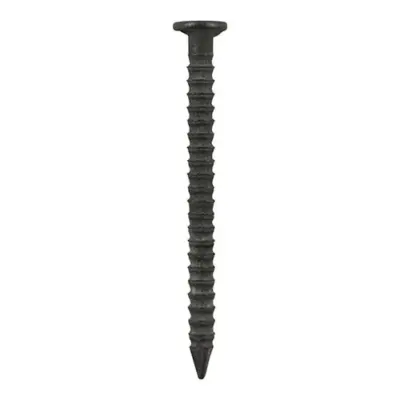
Sherardised annular ringshank nails with medium-duty rust protection and excellent holding power. Conforms to Eurocode 5 and service class 2. Available in multiple sizes and pack weights to suit the job.
Available options and pricing for Sherardised Annular Ringshank Nails | Multiple Sizes, with quantity selectors and a running total
Size
Weight
Pack Type
SKU
Price
QTY
Total
40 x 2.65mm
2.5kg
TIMtub
SAR40T
£12.61£15.13
—
50 x 2.65mm
2.5kg
TIMtub
SAR50T
£12.61£15.13
—
65 x 3.35mm
2.5kg
TIMtub
SAR65T
£12.61£15.13
—
40 x 2.65mm
1kg
TIMbag
SAR40B
£4.45£5.34
—
50 x 2.65mm
1kg
TIMbag
SAR50B
£4.45£5.34
—
65 x 3.35mm
1kg
TIMbag
SAR65B
£4.45£5.34
—
40 x 2.65mm
0.5kg
TIMbag
SAR40MB
£2.83£3.40
—
50 x 2.65mm
0.5kg
TIMbag
SAR50MB
£2.83£3.40
—
Ringshank nails are the go-to fixing where standard smooth-shank nails simply don’t hold well enough. The annular rings cut into the surrounding timber fibres as the nail is driven, locking it in place far more effectively than a plain wire nail. These sherardised ringshank nails are designed for structural and medium-duty timber applications where grip matters and moisture resistance is required.
Sherardising is a zinc-diffusion coating process that bonds zinc into the surface of the steel at a molecular level. The result is a uniform, hard-wearing coating that resists corrosion better than a standard galvanised nail and performs reliably in service class 2 conditions. These nails conform to Eurocode 5, which means they’re an approved choice for structural timber connections in engineered and frame construction. If your project needs a documented fixing, these are worth having on site.
Where Sherardised Ringshank Nails Are Used
These nails are used across a wide range of timber construction work. Roof truss assembly, floor deck fixing, timber frame construction, cladding and boarding, and fencing are all common applications. The ringshank profile is particularly useful anywhere the fixing will experience withdrawal forces, such as decking boards that cup slightly as they dry, or cladding that’s subject to wind load. In short, anywhere a smooth-shank nail has a habit of working loose over time.
Service class 2 compliance means these nails are suitable for use in covered, humid environments such as unheated buildings, agricultural structures, and external-facing timber that remains dry in service but is exposed to higher moisture levels during or after construction. They are not intended for permanently wet or submerged applications.
Size and Pack Options
These ringshank nails are available in three sizes: 40 x 2.65mm, 50 x 2.65mm, and 65 x 3.35mm. The 40mm and 50mm nails share the same gauge and suit lighter structural work and boarding. The 65 x 3.35mm is the heavier option for thicker timber sections and more demanding fixings. Pack options include 0.5kg, 1kg, and 2.5kg in both TIMbag and TIMtub formats, so whether you need a small supply for a single job or a bulk quantity for a larger site, there’s a practical pack to suit.
TIMtub packaging is particularly handy on site. The rigid tub keeps nails organised and accessible in a nail bag or toolbox without the bag splitting at an inconvenient moment. Small detail, but anyone who’s scattered a kilo of nails across a roof deck will appreciate it.
For reliable holding power, corrosion resistance, and compliance with structural timber standards, these sherardised ringshank nails are a sensible choice. Priced for trade use and available in practical pack sizes, they’re a straightforward stocking item for builders, roofers, and carpenters who need a fixing that does what it’s supposed to.
Pro Tip: When fixing roof deck boarding or cladding, drive ringshank nails at a slight angle rather than perfectly perpendicular to give extra resistance against board movement as the timber seasons.
Sherardised annular ringshank nails are used in structural timber construction, roof and floor deck fixing, timber frame assembly, fencing, and external cladding. They are a common choice wherever withdrawal resistance is a practical requirement, such as in decking, boarding onto joists, and panel fixing in humid or semi-exposed environments. Carpenters, roofers, and structural timber installers all use these regularly.
Not suitable for: These nails are not suitable for permanently wet or submerged conditions. Not recommended for use with copper, aluminium, or stainless steel fixings where electrolytic corrosion could occur.
Select the nail size appropriate to the timber thickness. As a general guide, nail length should be at least 2.5 times the thickness of the member being fixed through. Drive nails square or at a slight angle using a hammer or nail gun compatible with the shank diameter. Avoid over-driving, which can split the timber or damage the annular rings near the surface.
For structural applications subject to Eurocode 5, confirm spacing and edge distances in line with the design specification. The ringshank profile means the nail is significantly harder to withdraw than a smooth-shank nail, so positioning correctly first time matters more than it does with standard wire nails.
Select the correct nail size for the timber thickness, aiming for a nail length at least 2.5 times the thickness of the fixing member.
Check that edge and end distances comply with your structural specification where Eurocode 5 requirements apply.
Position the nail on the mark before driving to avoid repositioning, as ringshank nails are difficult to remove cleanly without timber damage.
Drive the nail straight or at a slight angle using a hammer or compatible pneumatic nail gun.
Avoid over-driving: the nail head should sit flush with the timber surface, not punched deep into the grain.
For deck or cladding work, maintain consistent nail spacing along each board to distribute withdrawal loads evenly.
What does sherardised mean and how does it compare to standard galvanising?
Sherardising is a zinc-diffusion process where zinc bonds into the steel surface under heat, producing a uniform, hard-wearing coating. It offers better adhesion and more consistent corrosion resistance than standard hot-dip galvanising, particularly on small fixings like nails where coating thickness can vary with hot-dip methods. It is rated for service class 2 conditions under Eurocode 5.
Can these ringshank nails be used with a nail gun?
Loose ringshank nails of this type are intended for hand nailing. If you need ringshank nails for a pneumatic nail gun, you will need collated nails in strip or coil format designed for your specific tool. Check the nail diameter and shank type against your gun's specification before use.
Which size should I choose for roof deck or floor deck fixing?
For standard 18mm OSB or plywood decking onto 45mm joists, the 50 x 2.65mm nail is typically sufficient. For thicker boarding or heavier structural members, the 65 x 3.35mm nail gives greater penetration and a larger shank diameter for increased load capacity. If the project has a structural specification, follow the nail schedule in the design drawings.
Sherardised annular ringshank nails are manufactured from steel wire with an annular-profiled shank and a zinc-diffusion surface treatment applied by the sherardising process. The coating provides medium-duty corrosion protection suitable for service class 2 environments as defined in Eurocode 5 (BS EN 1995-1-1). The annular ring profile increases the nail's resistance to axial withdrawal forces compared to smooth-shank wire nails of equivalent diameter.
Sizes Available
40 x 2.65mm, 50 x 2.65mm, 65 x 3.35mm
Pack Weights
0.5kg, 1kg, 2.5kg
Pack Types
TIMbag, TIMtub
Coating
Sherardised (zinc-diffusion)
Corrosion Protection
Medium duty
Standard
Eurocode 5 (BS EN 1995-1-1)
Service Class
Class 2
Shank Profile
Annular ringshank
Size
40 x 2.65mm, 50 x 2.65mm, 65 x 3.35mm
Weight
0.5kg, 1kg, 2.5kg
Pack Type
TIMbag, TIMtub
Reviews
There are no reviews yet.
Be the first to review “Sherardised Annular Ringshank Nails | Multiple Sizes”Cancel Reply






Reviews
There are no reviews yet.