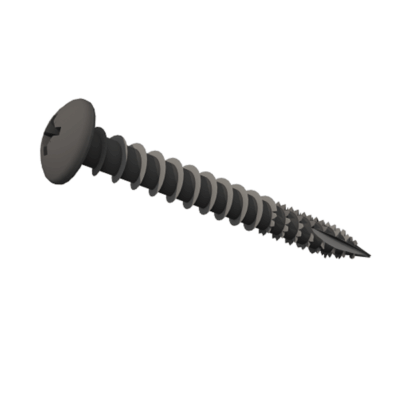
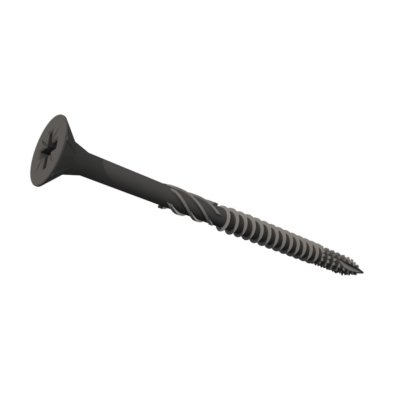
Black exterior coated pan head screws with 1,000-hour salt spray resistance, dual angle thread, and patented twin cut point. Available in a wide range of sizes, sold in boxes of 200. Built for demanding outdoor timber fixing work.
Available options and pricing for Black Exterior Coated Performance Screw Pan Head Box 200, with quantity selectors and a running total
Size
SKU
Price
QTY
Total
5.0 x 30mm
CC2TUB-1-1-2
£3.77£4.52
—
4.0 x 25mm
CC2TUB-1-1-3
£2.48£2.98
—
4.0 x 30mm
CC2TUB-1-1-4
£2.69£3.23
—
4.0 x 40mm
CC2TUB-1-1-5
£2.99£3.59
—
4.0 x 50mm
CC2TUB-1-1-6
£3.49£4.19
—
5.0 x 40mm
CC2TUB-1-1-7
£4.38£5.26
—
5.0 x 50mm
CC2TUB-1-1-8
£4.98£5.98
—
These black exterior coated pan head screws are designed for outdoor timber fixing where weather resistance and holding strength matter. The multi-layer coating combines a zinc base layer with an organic top coat barrier, giving each screw a tested 1,000-hour salt spray resistance. That means they hold up in exposed conditions without the surface corrosion that lets cheaper screws down over time. If you are fixing cladding, decking frames, fencing, or external timber structures, these exterior pan head screws are built for the job.
The dual angle thread is where these screws earn their keep. The thread geometry is designed to maximise pull-out resistance, which matters when you are fastening into structural or load-bearing timbers. This is not just about getting the screw in — it is about keeping it there under load, season after season. The pan head profile sits flush against the surface without pulling through, making it a practical choice wherever a countersunk head would not suit the material.
What Makes These Exterior Pan Head Screws Different
The patented twin cut point technology is worth understanding. The twin cut tip bites into timber quickly on first contact, which speeds up installation and, more usefully, significantly reduces the risk of splitting the timber as the screw drives home. On hardwoods, or near the end grain of any timber, this makes a real practical difference. No one wants to pre-drill every hole on a 200-screw job if they do not have to.
Thread length is handled sensibly across the size range. All sizes up to and including 75mm are fully threaded, which gives maximum grip across the full shank length. For screws 80mm and above, the thread runs for 70mm from the tip. This means you get a strong threaded engagement into the substrate while the smooth shank above resists side-loading forces, which is particularly useful on longer fixings into structural posts or deep-section timber.
Sizing and Thread Notes
The range covers diameters from 3.5mm up to 6.0mm and lengths from 25mm through to 150mm, so there is a suitable size for most external timber fixing tasks. Whether you are fixing a batten, building a pergola, or hanging external boarding, there is a size in the range that fits the job. The box of 200 is a practical working quantity for most medium-to-large jobs, reducing the chance of running short halfway through a run of boards.
The black coating also serves a visual purpose. On dark timber, dark composite boarding, or any application where silver screw heads would stand out, the black finish sits neatly and does not draw the eye. It is a small detail, but on a finished garden structure or visible external surface, it matters. These exterior pan head screws combine a clean appearance with the kind of corrosion resistance that stands up to UK weather conditions without fuss.
Pro Tip: When driving these screws into hardwood or dense engineered timber, reduce your drill driver speed and let the twin cut point do the work — forcing it fast generates heat and can strip the drive recess before the screw is fully seated.
Black exterior coated pan head screws are used across a wide range of outdoor timber construction and carpentry work. Common applications include garden structures such as pergolas, arbours, and raised planters, as well as fencing, external cladding battens, decking subframes, and outbuilding construction. The black finish makes them a popular choice for visible fixings on composite and dark-stained timber surfaces where appearance matters alongside performance.
These screws are also used by groundworkers and landscapers fixing external boarding and retaining structures, and by site carpenters working on external joinery where a durable coated fastener is specified. The wide size range means a single product line can cover most timber fixing needs across a project without switching to different screws mid-job.
Best For
External timber cladding and battens
Fencing and garden structures
Decking subframes
Pergolas and outdoor joinery
External outbuilding construction
Compatible Materials
Softwood timber
Hardwood timber
Engineered and treated timber
Composite boarding (into timber substrate)
External boarding and sheet materials
Key Properties
1,000-hour salt spray resistance
Multi-layer zinc base and organic top coat
Dual angle thread for high pull-out resistance
Patented twin cut point reduces timber splitting
Full thread on sizes up to 75mm
70mm thread length on sizes 80mm and above
Black finish for discreet appearance on dark surfaces
Not suitable for: Not suitable for use in direct contact with salt water immersion or permanently wet conditions beyond the rated 1,000-hour salt spray resistance. These screws are designed for external timber fixing and are not intended for use in masonry, concrete, or metal sheet applications.
Select the correct screw diameter and length for the timber thickness and substrate. As a general guide, the screw should penetrate the receiving timber by at least twice the diameter of the screw for adequate pull-out strength. For most external timber fixing, a 4.0mm or 5.0mm diameter screw will cover the majority of applications.
A variable speed drill driver set to a moderate torque is recommended. The twin cut point is designed to bite without pre-drilling in most softwood timbers, but hardwoods or fixings near the end grain may benefit from a small pilot hole to prevent splitting and ensure straight entry. Drive to flush or just below the surface without over-torquing, which can compress the timber and reduce holding strength.
Select the appropriate screw size for the timber thickness, ensuring the screw will penetrate the substrate by at least twice the screw diameter.
Check that the pan head profile is suitable for the application and will sit correctly against the surface material.
For hardwoods or fixings within 50mm of the end grain, drill a pilot hole slightly smaller than the screw shank to prevent splitting.
Set your drill driver to a moderate speed and appropriate torque setting for the timber density.
Position the screw on the marked fixing point and apply light pressure to the twin cut point before starting the driver.
Drive the screw steadily to flush or just below the surface without over-driving into the timber face.
Check seating and repeat for remaining fixings, adjusting torque as needed if timber density varies.
What does 1,000-hour salt spray resistance mean in practice?
Salt spray testing is a standardised corrosion test that simulates aggressive coastal or exposed conditions. A 1,000-hour rating means the screw's coating has passed extended exposure without significant corrosion, which translates to good long-term performance in typical UK outdoor conditions including rain, frost, and general weathering. It does not mean they are suitable for continuous immersion in water or direct marine splash zones.
Do I need to pre-drill for these screws in softwood timber?
In most softwood timbers, pre-drilling is not required. The patented twin cut point is designed to bite and advance without a pilot hole, which is part of what makes them quick to install. For hardwoods, dense engineered timber, or fixings close to the end grain, a small pilot hole is recommended to avoid splitting and to get a straighter drive.
Why choose a pan head over a countersunk head for external timber fixing?
A pan head sits on the surface rather than pulling flush into the timber. This makes it the better choice where countersinking would weaken the material, particularly in thinner boards or composite surfaces that do not take a countersunk profile cleanly. Pan heads also provide a larger bearing face, which distributes the clamping load across more surface area and can improve hold on softer or layered materials.
These pan head wood screws feature a multi-layer corrosion protection system consisting of a zinc base layer and an organic top coat barrier, achieving a tested 1,000-hour salt spray resistance in accordance with standard corrosion testing protocols. The dual angle thread geometry is engineered to maximise pull-out resistance in timber substrates. The patented twin cut point reduces insertion torque and minimises timber splitting on entry. Full thread is applied to all lengths up to and including 75mm; lengths of 80mm and above carry a 70mm threaded section from the tip.
Head Type
Pan Head
Coating
Multi-layer: zinc base layer with organic top coat barrier
Salt Spray Resistance
1,000 hours
Thread Type
Dual angle
Point Type
Patented twin cut
Thread Length
Full thread up to 75mm; 70mm thread on lengths 80mm and above
Available Diameters
3.5mm, 4.0mm, 5.0mm, 6.0mm
Available Lengths
25mm to 150mm
Box Quantity
200 (varies by size)
Finish
Black exterior coated
Size
3.5 x 45, 4.0 x 25mm, 4.0 x 30, 4.0 x 30mm, 4.0 x 40, 4.0 x 40mm, 4.0 x 50, 4.0 x 50mm, 4.0 x 60, 4.0 x 60mm, 4.0 x 70, 4.0 x 70mm, 5.0 x 100, 5.0 x 100mm, 5.0 x 30mm, 5.0 x 40, 5.0 x 40mm, 5.0 x 50, 5.0 x 50mm, 5.0 x 60, 5.0 x 60mm, 5.0 x 70, 5.0 x 70mm, 5.0 x 80, 5.0 x 80mm, 6.0 x 100, 6.0 x 100mm, 6.0 x 130mm, 6.0 x 150mm, 6.0 x 40, 6.0 x 40mm, 6.0 x 50, 6.0 x 50mm, 6.0 x 70, 6.0 x 70mm


Reviews
There are no reviews yet.