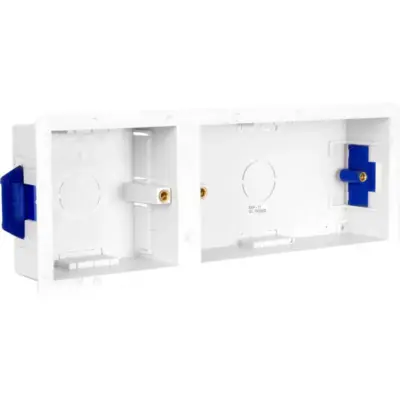
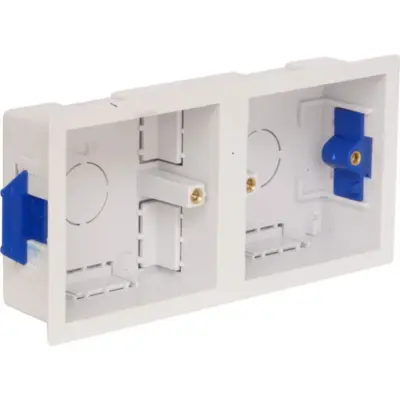
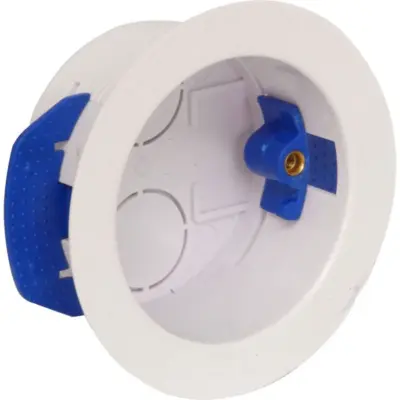
A dual dry lining box combining a 1-gang and 2-gang aperture in a single back box. Available in 35mm and 45mm depths. White finish. Standard fit for plasterboard stud walls.
The dual 1G+2G dry lining box is one of those fittings that earns its place on any first fix electrical job. It combines a single-gang and a double-gang aperture in one back box, which means you can run a socket and a switch from the same location without needing two separate boxes or any creative plasterboard surgery. Available in 35mm and 45mm depths, it suits most standard stud partition and dry lining situations.
Dry lining boxes are designed specifically for plasterboard walls. Rather than being surface-mounted or set into blockwork, they grip the board from behind using lugs or wings that bite as you tighten the fixing screws. No plugs, no drilling into masonry, no mess. It is the standard approach for stud walls in residential and commercial fit-outs, and electricians who work these jobs regularly will know the routine well.
Where the Dual 1G+2G Dry Lining Box Earns Its Keep
The dual format is particularly useful in rooms where you need both a switched spur and a socket at the same point, or a USB charger outlet alongside a light switch. Kitchens, home offices, and commercial fit-out partitioning are all common applications. Rather than chasing in two separate boxes and patching around them, a single dual box keeps the plasterboard intact and the finish cleaner.
The 45mm depth variant gives a bit more room to work with when you have a busier back box, which is worth considering if conduit entries or thicker cables are involved. The 35mm version suits tighter stud spacings or shallower voids where depth is limited.
White finish means it sits neatly behind white faceplates without any shadow or colour mismatch around the edge. A small detail, but one that matters on a clean install. These are available in bulk from DTS, which makes them straightforward to stock ahead of larger fit-out contracts.
Pro Tip: When fitting into 12.5mm plasterboard, make sure the wings fully deploy before final tightening, or the box will pull through under load from the faceplate screws.
Dual 1G+2G dry lining boxes are used throughout first fix electrical work on stud partition and plasterboard walls. They are a standard fixture in new build residential properties, commercial office fit-outs, and refurbishment projects where internal walls are constructed using metal or timber studwork. Electricians use them wherever two outlet positions are needed at the same point on a wall without the need for a larger combined back box or additional plasterboard cutting.
Best For
Stud partition walls
Plasterboard dry lining
Residential first fix
Commercial office fit-outs
Refurbishment on stud walls
Available In
35mm depth
45mm depth
White finish
Key Features
Dual 1-gang and 2-gang aperture in one box
Dry lining lug fixing, no masonry fixings required
Standard plasterboard wall installation
White colour to suit standard faceplates
Suitable for 12.5mm plasterboard
Not suitable for: Not suitable for solid masonry or concrete walls, where a surface pattress or dry-lined approach would be needed instead. Not intended for external or damp environments.
Mark and cut the aperture in the plasterboard to the correct size for the dual box. Feed cables through the box entry points before offering it up to the hole. Push the box into the aperture, tighten the fixing screws to deploy the lugs behind the board, and check the box sits flush and level before completing the first fix connection.
Mark the wall position for the dual box using a template or the box itself as a guide
Cut the plasterboard aperture cleanly using a pad saw or jab saw
Knock out the cable entry points required on the box
Feed cables through the appropriate entry points before pushing the box into position
Push the box fully into the aperture until the front face sits flush with the board surface
Tighten the fixing screws evenly to draw the lugs tight against the back of the plasterboard
Check the box is level and secure before first fix connections are made
What is the difference between the 35mm and 45mm depth options?
The 45mm box gives more internal volume for cable management and conduit connections. If you are running thicker cables or multiple entries, the extra depth makes terminating the faceplate considerably easier. The 35mm version suits situations where the stud void is shallower or space behind the board is restricted.
Will this box work with standard 1-gang and 2-gang faceplates?
Yes. The dual 1G+2G format is designed to accept a standard 1-gang faceplate on one aperture and a standard 2-gang faceplate on the other, so you can use any off-the-shelf socket, switch, or module outlet that fits those standard sizes.
How thick does the plasterboard need to be for the lugs to grip properly?
These boxes are designed for standard 12.5mm plasterboard, which is the most common thickness used in UK stud partition walls. They will also work on 15mm board. If the plasterboard is significantly thinner, the lugs may not grip securely, so check the manufacturer guidance for your specific board thickness.
Constructed from flame-retardant thermoplastic, dry lining boxes are manufactured to meet standard UK electrical installation requirements for use behind plasterboard faceplates. The lug fixing mechanism engages mechanically against the back face of the board as the screws are tightened, providing a secure hold without adhesive or masonry fixings. Available in 35mm and 45mm depths in white.
Colour
White
Available Depths
35mm, 45mm
Wall Type
Dry lining / plasterboard stud walls
Aperture Configuration
1-gang + 2-gang (dual)
Fixing Method
Dry lining lugs (plasterboard grip)
Material
Flame-retardant thermoplastic
Size
35mm, 45mm
Reviews
There are no reviews yet.
Be the first to review “Dual (1G+2G) Dry Lining Box (White)”Cancel Reply

Reviews
There are no reviews yet.