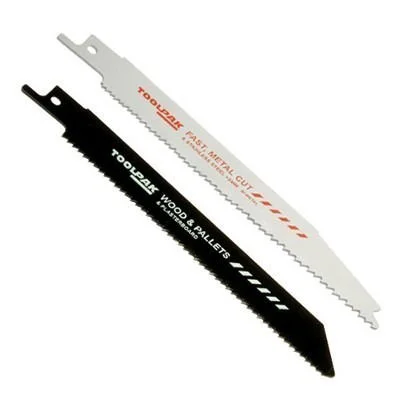
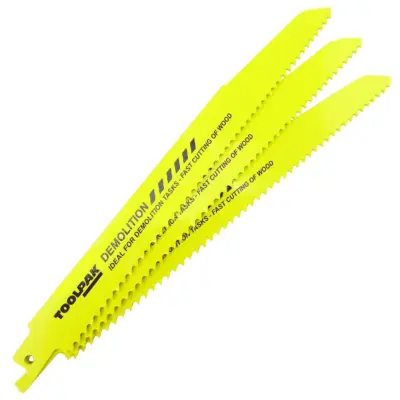
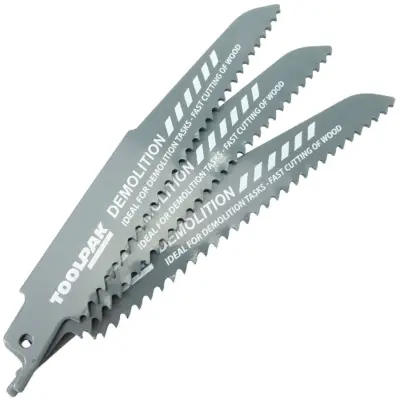
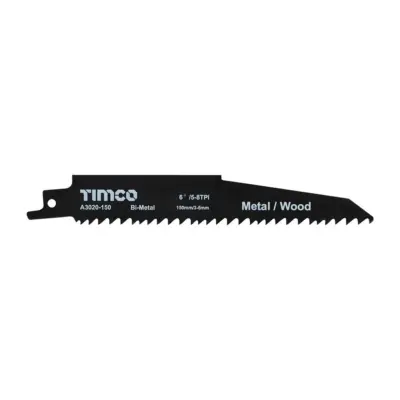
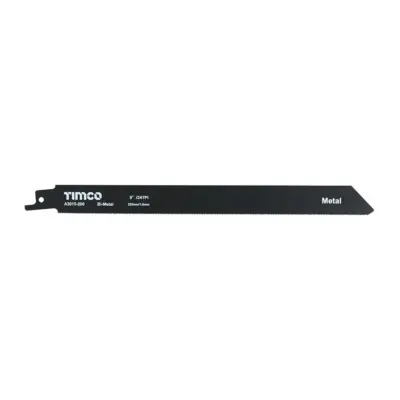
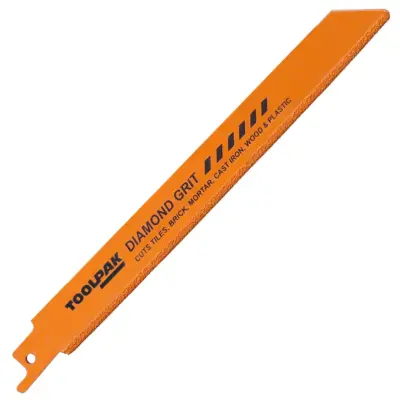
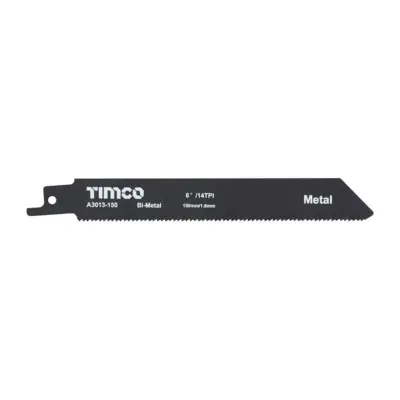
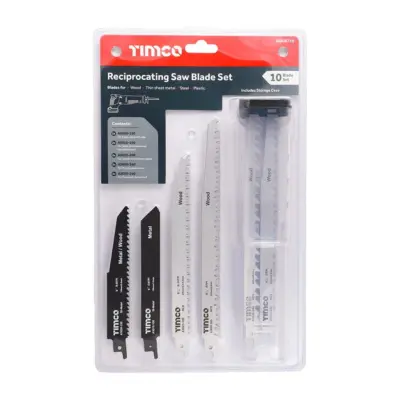
A range of reciprocating saw blades covering wood, metal, sheet steel, plastics and nails. Sold in packs of 5, these are the blades that actually get used on site day in, day out. Sizes from 150mm to 305mm.
Size
Price
QTY
150mm Wood Blade
£6.90£8.28
150mm Metal Blade
£4.44£5.33
150mm Wood Blade
£5.97£7.16
150mm Metal Blade
£11.75£14.10
150mm Metal Blade
£8.90£10.68
225mm Metal Blade
£11.90£14.28
225mm Wood with Nails / Metal Blade
£12.90£15.48
240mm Wood Blade
£4.93£5.92
300mm Wood and Metal Blade
£17.90£21.48
305mm Wood Blade
£16.90£20.28
Reciprocating saw blades are one of those consumables where buying the wrong type costs you time, teeth, or both. This range covers the most commonly needed blade types across wood, metal, bi-metal, and sheet steel cutting — the blades tradespeople actually reach for on a daily basis, rather than a novelty selection you’ll never finish.
The lineup spans 150mm through to 305mm, with options matched to specific cutting jobs. Short blades like the S744D and S922AF give you control in tight spaces — the S744D rips through wood and plastics quickly, while the S922AF handles thin sheet metal down to 0.7mm without tearing. Both are 150mm, which makes them easier to manage in confined demolition work or under-floor cuts.
Mid-range blades at 225mm hit a useful balance between reach and rigidity. The S1122EF is designed for thin sheet metal between 1.5mm and 4mm, and works well on pipes and profiles up to 175mm. The S811H is the one to grab when you’re not entirely sure what’s in the wall — it cuts wood, metal, and plasterboard, and handles nails in timber up to 100mm. Handy when you’d rather not find out the hard way that there’s a fixing buried in your cut line.
Reciprocating Saw Blade Options for Longer Cuts
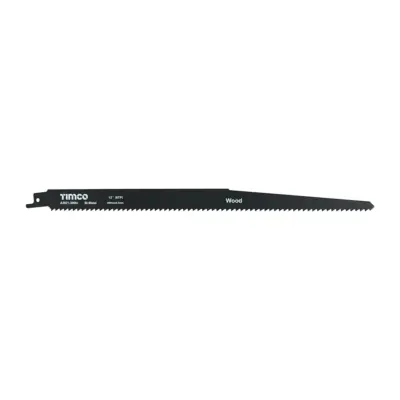
When reach matters more than compactness, the 240mm and 305mm blades come into their own. The S1531L at 240mm is a coarse wood blade running at 5tpi with a 5mm tooth pitch — good for structural timber, pruning, and firewood cuts up to 190mm diameter. It’s aggressive and fast, not a blade for anything that needs a tidy finish.
The S1344D at 305mm is similarly coarse, built for rapid removal rather than precision. Demolition, rough framing cuts, strip-out work — that’s where it earns its keep. At 305mm it’s one of the longer options in the range, giving you clearance on deep sections where a shorter blade would bind.
All blades are sold in packs of 5, making them straightforward to stock up without committing to large quantities you don’t need.
Pro Tip: Match blade length to material depth, not just cutting direction: a blade that bottoms out in a thick section will flex, wander and wear the teeth unevenly, so go longer than you think you need on deep cuts.
These reciprocating saw blades cover the bulk of what comes up on a typical site. Demolition and strip-out work, cutting studwork and timber frames, slicing through plasterboard, removing nails embedded in joists, cutting sheet steel and metal profiles for fabrication or fit-out. The S811H in particular gets used in situations where the material is unknown or mixed, which is most of demolition. Metal-cutting blades like the S922AF and S1122EF suit mechanical and plumbing trades working with pipe, box section, and thin steel. The longer coarse blades are common in groundworks and outdoor cutting where speed matters more than finish quality.
Best For
Demolition and strip-out work
Structural timber and framing cuts
Sheet metal and thin steel profiles
Plasterboard and mixed-material cutting
Pipe and tube cutting
Pruning and rough outdoor timber work
Available Blade Types
Wood cutting (HCS)
Metal cutting (BIM/HSS)
Wood and metal bi-material
Wood with nails
Sheet metal and profiles
Flexible metal blades
Key Specifications
Lengths: 150mm, 225mm, 240mm, 300mm, 305mm
S1531L: 5tpi, 5mm tooth pitch
S922AF: suitable for sheet metal 0.7-3mm
S1122EF: sheet metal 1.5-4mm, pipes up to 175mm
S811H: wood with nails 3-100mm, non-ferrous metal 3-100mm
Sold in packs of 5
Not suitable for: Fine finish cutting or precise joinery work — these are site and demolition blades, not cabinet-making blades. Not designed for cutting masonry, ceramics, or hardened steel.
Fit the blade to your reciprocating saw using the standard shank system — all blades in this range use a universal shank compatible with the vast majority of reciprocating saws on the market. Select the blade type based on your material first, then choose the length based on how much depth you need to clear.
For metal cutting, use a slower stroke rate and let the blade do the work. Forcing the pace generates heat, dulls teeth faster, and can warp thinner blades. On wood, especially with the coarser 5tpi blades, a faster stroke and gentle forward pressure gives the cleanest result. Keep the shoe pressed firmly against the workpiece to reduce vibration and improve blade life.
Select the correct blade for your material using the blade guide above
Ensure the saw is unplugged or battery removed before changing blades
Insert the blade into the saw's tool-free or keyed chuck until it locks securely
Press the saw shoe firmly against the material surface before starting the cut
Match stroke speed to material: lower for metal, higher for wood
Apply steady forward pressure without forcing — let the blade cut at its own pace
Replace blades when cutting slows noticeably or teeth appear worn or bent
Are these blades compatible with all reciprocating saws?
All blades in this range use a standard universal shank, which fits the vast majority of reciprocating saws including Bosch, DeWalt, Milwaukee, Makita and most other brands. If your saw uses a proprietary fitting, check the manufacturer's compatibility before ordering.
Which blade should I use for cutting wood that might have nails in it?
The S811H is the one for that job. It's a bi-material blade rated for wood with nails up to 100mm, as well as non-ferrous metals in the same thickness range. It's the sensible choice for demolition timber where you can't guarantee what's buried in it.
How many blades come in a pack?
Each pack contains 5 blades of the selected type and size. That applies across all variants in the range, whether you're ordering 150mm wood blades or 305mm coarse-cut blades.
The range includes HCS (High Carbon Steel) blades for wood and plastic cutting, and BIM (Bi-Metal) or HSS blades for metal cutting duties. HCS blades are well suited to softer materials where flexibility is less critical. Bi-metal construction on the metal-cutting variants gives improved heat resistance and tooth durability under the friction generated by steel cutting. Flexible blade variants such as the S922AF and S922EF are designed to resist lateral snapping in confined or angled cuts.
Available Lengths
150mm, 225mm, 240mm, 300mm, 305mm
Pack Quantity
5 blades
Blade Materials
HCS, Bi-Metal
S1531L Tooth Pitch
5mm (5tpi)
S922AF Sheet Metal Range
0.7-3mm
S1122EF Sheet Metal Range
1.5-4mm
S811H Nail/Wood Range
3-100mm
Shank Type
Universal
Weight
N/A
Product Type
Reciprocating Sabre Saw Blades
Size
150mm Metal Blade, 150mm Wood and Metal Blade, 150mm Wood Blade, 225mm Metal Blade, 225mm Wood and Metal Blade, 225mm Wood Blade, 225mm Wood with Nails / Metal Blade, 240mm Metal Blade, 240mm Wood and Metal Blade, 240mm Wood Blade, 300mm Metal Blade, 300mm Wood and Metal Blade, 300mm Wood Blade, 305mm Metal Blade, 305mm Wood and Metal Blade, 305mm Wood Blade
Box Quantity
5
Reviews
There are no reviews yet.
Be the first to review “Reciprocating Saw Blades – Best Selling Range”Cancel Reply

Reviews
There are no reviews yet.