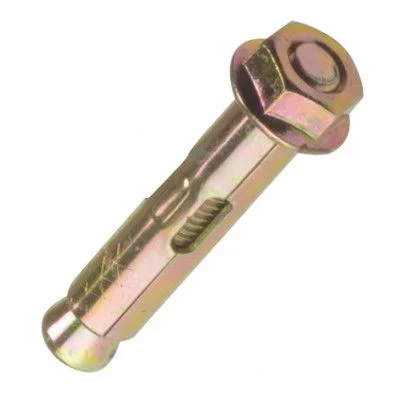
Thin-walled steel hex nut sleeve anchors with ZYP finish, suitable for fixing window frames, partitions, cabinets and structural elements into concrete and masonry. Available in multiple M8 to M16 sizes with bulk box quantities.
Size
QTY
Price
QTY
M16 x 100mm
25
£24.13£28.96
M8 x 40mm
50
£6.89£8.27
M8 x 65mm
50
£9.20£11.04
M10 x 50mm
50
£14.87£17.84
M10 x 77mm
50
£15.20£18.24
M10 x 97mm
25
£7.63£9.16
M12 x 75mm
25
£12.45£14.94
M12 x 60mm
25
£10.58£12.70
M12 x 99mm
25
£11.57£13.88
M12 x 129mm
25
£11.96£14.35
M16 x 147mm
20
£13.82£16.58
Hex nut sleeve anchors are one of those fixings that get used on almost every site, quietly doing the job while nobody gives them a second thought. That is exactly what a good fixing should do. These thin-walled steel sleeve anchors come with a hex nut head and a zinc yellow passivate finish, giving them decent resistance to the kind of corrosion you get in damp internal environments. The sleeve expands into the base material as you tighten the nut, locking the anchor firmly in place in concrete, brick, blockwork and most solid masonry substrates.
Available in M8, M10, M12 and M16 diameters across a range of lengths from 40mm up to 147mm, there is a size here for most structural and secondary fixing applications. Short lengths suit thinner fixings like frame brackets and cabinet mounting plates. Longer variants give you the embedment depth needed when you are going into softer or less dense masonry, where you want the sleeve well into the solid material rather than sitting in the render or screed layer.
Where Hex Nut Sleeve Anchors Get Used
These are a practical everyday anchor for tradespeople across multiple trades. Joiners reach for them when hanging window frames and door frames into concrete reveals. Shopfitters use them for partitioning and cabinet installation. Electricians and mechanical engineers use the M8 and M10 sizes for plant brackets, cable management tray supports and equipment mounting. The M12 and M16 sizes earn their place when you are fixing structural steel plates, heavy shelving systems or anything carrying meaningful load.
ZYP Finish
The zinc yellow passivate coating is not a premium weather seal, but it does give useful protection against surface corrosion during installation and in dry to mildly damp indoor conditions. For exposed external applications or areas with standing moisture, a stainless or hot-dip galvanised anchor would be the better call.
Supplied in box quantities of 20, 25 or 50 depending on size, so whether you need a small batch for a one-off job or a full box to see a project through, you are not stuck buying a size that does not suit your run.
Pro Tip: Always drill to the full length of the anchor body, not just the diameter, so the sleeve has room to expand fully and the anchor reaches its rated holding strength.
Hex nut sleeve anchors are used across a broad range of fixing tasks in construction and fit-out. Window frame installation into concrete reveals, partition wall systems, cabinet and shelving mounting, equipment brackets, cable tray supports and structural steel plate fixings are all common applications. They work in solid concrete, dense aggregate block, brick and most formed masonry where there is enough material for the sleeve to expand against.
Best For
Window and door frame fixing
Partition and drywall systems
Cabinet and shelving installation
Cable tray and equipment brackets
Structural steel plate attachment
Plant and machinery mounting
Compatible Surfaces
Solid concrete
Dense aggregate blockwork
Brick
Formed masonry
Stone (solid)
Key Specifications
Material: steel with ZYP finish
Head type: hex nut
Sizes: M8, M10, M12, M16
Lengths: 40mm to 147mm
Box quantities: 20, 25 or 50
Expansion type: sleeve anchor
Not suitable for: Not suitable for hollow block, cavity brick or lightweight aerated concrete where the sleeve has no solid material to expand against. The ZYP finish is not adequate for fully exposed external or permanently wet environments.
Drill the correct diameter hole to the full depth of the anchor using a hammer drill and masonry bit. Clear the hole of dust before inserting the anchor. Thread your fixing through the item being attached, insert the anchor body into the hole, then tighten the hex nut with a spanner. As the nut is tightened, it draws the cone up into the sleeve, forcing it to expand against the walls of the drilled hole.
Do not overtighten, particularly in softer brick or blockwork. Snug and firm is the target. If the anchor spins in the hole, the hole is oversized or the material is too soft for this type of fixing.
Select the correct anchor size for the bolt diameter and required embedment depth
Fit the appropriate masonry bit and set the hammer drill to hammer mode
Drill to the full length of the anchor body, keeping the drill perpendicular to the surface
Clear the hole thoroughly with a blowout pump or brush to remove dust
Pass the anchor through the fixing hole in your bracket, frame or plate
Insert the anchor assembly into the drilled hole until the flange sits flush
Tighten the hex nut with a spanner until the sleeve is fully expanded and the fixing is secure
What drill bit size should I use for M10 hex nut sleeve anchors?
M10 sleeve anchors require a 10mm masonry bit. Always match the drill diameter exactly to the anchor diameter — going even slightly oversize reduces the grip the sleeve can achieve against the hole walls.
Can these sleeve anchors be used in aerated concrete blocks?
No. Aerated or lightweight concrete blocks do not provide enough resistance for the sleeve to expand against. These anchors need solid, dense base material. Use a specialist resin anchor system in aerated block instead.
Are these sleeve anchors suitable for outdoor use?
The ZYP coating gives reasonable protection in dry indoor conditions but is not rated for exposed external environments. For outdoor fixing or areas exposed to moisture long term, specify a stainless steel or hot-dip galvanised anchor.
Constructed from steel with a zinc yellow passivate surface treatment, these sleeve anchors use a mechanical expansion principle where tightening the hex nut draws a tapered cone into the sleeve body, forcing it to expand radially against the drilled hole. The thin-walled sleeve design allows installation close to edges compared to heavier shield anchor types, while still developing good pull-out and shear resistance in solid masonry substrates.

Reviews
There are no reviews yet.