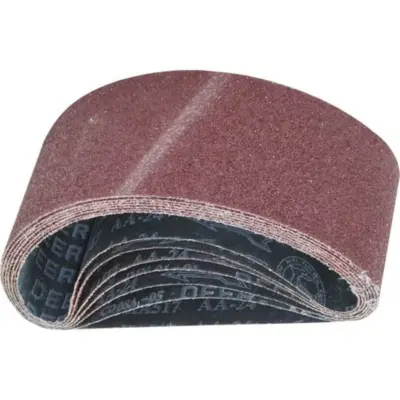
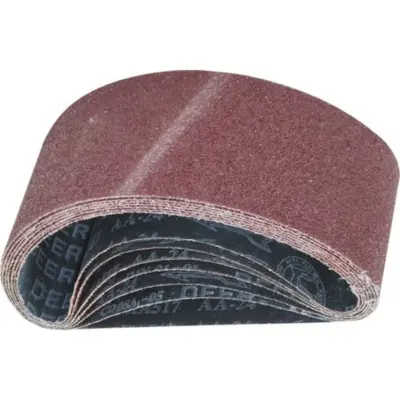
Aluminium oxide sanding belts with resin-bonded X-weight backing cloth. Available in 40g, 60g, 80g and 120g grits across two common belt sizes. Overlap joint with top-skive reduces chatter. Sold in packs of 5.
Size
Grit
Price
QTY
75mm x 533mm
120g
£4.29£5.15
75mm x 533mm
80g
£4.29£5.15
75mm x 533mm
60g
£4.29£5.15
75mm x 533mm
40g
£4.29£5.15
100mm x 610mm
40g
£5.29£6.35
100mm x 610mm
60g
£5.29£6.35
100mm x 610mm
80g
£5.29£6.35
100mm x 610mm
120g
£5.29£6.35
Sanding belts are one of those consumables you always seem to run out of at the wrong moment. These aluminium oxide belts cover the two sizes most tradespeople actually reach for: 75mm x 533mm and 100mm x 610mm, with grit options running from a coarse 40g all the way up to a finishing 120g. Whether you’re stripping back old paint, flatting down timber or keying a surface before coating, there’s a belt here for the job.
The abrasive grain is aluminium oxide, resin bonded onto an X-weight backing cloth. X-weight cloth is the stiffer, more hard-wearing of the standard backing options, which matters on a belt sander running at speed. It holds its shape under pressure rather than folding or creasing mid-pass, which keeps the cut consistent and reduces the chance of the belt tracking off the platen.
Where These Sanding Belts Earn Their Keep
The overlap joint includes an extra top-skive, which is worth mentioning because it’s the bit that reduces the chatter and judder you sometimes get as the joint passes under the workpiece. A poorly skived joint on a belt sander is immediately obvious, and on fine finishing work it leaves a repeat mark across the surface. These are designed to run smoothly, which makes a real difference on longer sessions.
Suitable for wood, paint, varnish, plastics, plasters and metal, so they’ll handle most of what comes up on a typical job. The coarser grits shift material quickly, the finer ones leave a surface ready for primer or finish coat. Grab a couple of different grits in the same size and you’ve got a sensible progression without spending much.
At this price for a pack of five, it makes sense to keep a few packs on the van in the grits you use most. Running out of 80g halfway through a floor or a door blank is not anyone’s idea of a good afternoon.
Pro Tip: On a belt sander running coarse grit, let the machine do the work at a consistent pace rather than pressing hard into the surface, forcing it tends to load the belt faster and generates heat that glazes the abrasive grain well before the belt is actually worn out.
These sanding belts are used across joinery, site finishing, metalwork and general preparation work. Common applications include stripping paint and varnish from timber, flatting down filler or plaster, keying metal surfaces before painting, and finishing MDF or softwood before coating. They suit belt sanders used in workshops and on site, covering tasks from heavy stock removal with coarser grits right through to final flatting with the 120g.
Best For
Stripping paint and varnish from timber
Flatting filler and plaster surfaces
Keying metal before painting
Finishing MDF and softwood
Stock removal on hardwood and softwood
Works With
75mm x 533mm belt sanders
100mm x 610mm belt sanders
Bench-mounted belt and disc sanders
Portable site belt sanders
Key Features
Aluminium oxide abrasive grain
Resin bonded X-weight backing cloth
Overlap joint with top-skive for reduced chatter
Available in 40g, 60g, 80g and 120g grits
Two sizes: 75x533mm and 100x610mm
Sold in packs of 5
Not suitable for: Not suitable for wet sanding applications or use on glass. The X-weight cloth backing is designed for dry belt sanding machines and is not intended for orbital or disc sanders.
Fit the belt to your sander with the direction arrow on the inside of the belt matching the rotation direction of the machine. Always check tracking before pressing the belt onto the workpiece. Start with the coarsest grit needed to remove material efficiently, then work progressively through finer grits to achieve the finish you're after.
Keep the sander moving at a steady, consistent pace. Dwelling in one spot generates heat and loads the belt quickly, shortening its life noticeably. On metal, a light application of cutting fluid or wax can help the belt run cooler and last longer.
Select the appropriate grit for the task: 40g or 60g for heavy removal, 80g for general flatting, 120g for finishing
Check the direction arrow printed on the inside of the belt and fit it so rotation matches the arrow
Switch the sander on and adjust the tracking so the belt runs centrally on the platens before starting work
Work along the grain on timber where possible, keeping the machine moving at a steady pace
Progress through finer grits in sequence rather than jumping straight to a fine grit on a rough surface
Replace the belt when cutting slows noticeably or the surface finish deteriorates, rather than pushing a worn belt
Which grit should I start with for stripping old paint from timber?
For stripping paint or varnish from timber, start with 40g or 60g to remove the bulk of the coating quickly. Once you're down to bare wood, move to 80g to remove the scratches left by the coarser grit, then finish with 120g if you need a smooth surface before priming or coating.
Will these belts fit my belt sander?
These belts are available in two standard sizes: 75mm x 533mm and 100mm x 610mm. Check the size printed on your existing belts or in your sander's manual before ordering. Most common portable and bench-mounted belt sanders in the UK use one of these two sizes, but it's worth confirming before you run out mid-job.
Abrasive grain is aluminium oxide, a hard-wearing synthetic mineral well suited to general-purpose sanding across wood, metal and painted surfaces. The grain is resin bonded to an X-weight backing cloth, which provides stiffness and tear resistance under the mechanical stress of belt sanding. The overlap joint uses a top-skive to reduce the thickness variation at the join point, minimising chatter and surface marking as the joint passes the platen.
Abrasive Type
Aluminium oxide
Bonding
Resin bonded
Backing
X-weight cloth
Joint Type
Overlap with top-skive
Available Sizes
75mm x 533mm, 100mm x 610mm
Available Grits
40g, 60g, 80g, 120g
Pack Quantity
5 belts per pack
Weight
N/A
Size
100mm x 610mm, 75mm x 533mm
Box Quantity
10
Product Type
100 X 610mm Sanding Belts
Grit
120g, 40g, 60g, 80g
Reviews
There are no reviews yet.
Be the first to review “Sanding Belts – Pk 5”Cancel Reply

Reviews
There are no reviews yet.