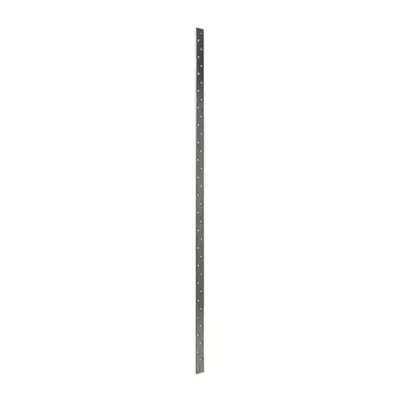
Heavy duty galvanised straight restraint straps for tying roof trusses, rafters and joists to masonry. Designed to BS 5268 Part 3 and Building Regulations for horizontal restraint. Sold in packs of 10.
Size
Price
QTY
900 x 30 x 100mm TWIST
£26.84£32.21
1500 x 30 x 100mm TWIST
£41.90£50.28
1000 x 30 x 100mm TWIST
£18.90£22.68
1200 x 30 x 100mm TWIST
£23.90£28.68
600 x 30 x 100mm TWIST
£29.90£35.88
800 x 30 x 100mm TWIST
£32.90£39.48
Galvanised straight restraint straps are a standard fix on any new build or renovation where timber roof structures meet masonry walls. These heavy duty straps are used to tie roof trusses, rafters and joists back to the supporting masonry, keeping the roof structure anchored against lateral movement. They comply with BS 5268 Part 3 and the relevant Building Regulations for horizontal restraint, so you are covered on any building control inspection without having to dig out a datasheet and argue the toss.
The straps are manufactured from galvanised steel, which gives them solid corrosion resistance for the long term. Once they are built into the structure, they are staying there, so it matters that the material holds up. Galvanising is the right choice here — hot-dip galvanised steel in a roof void is going to outlast any uncoated alternative without much debate.
Where Galvanised Straight Restraint Straps Fit Into the Build
Restraint straps sit in a fairly unglamorous part of the job. Nobody photographs them. But building control does check them, and a missed or incorrectly installed strap can hold up a sign-off. Getting the right length matters — too short and you cannot achieve the required fixing centres, too long and you are bending them to fit, which defeats the purpose of buying a straight strap in the first place.
These are available in six lengths from 600mm up to 1500mm, all at 30mm wide with a 100mm fixing zone, covering the range of wall thicknesses and joist depths you are likely to encounter on a typical domestic build or extension. The 10-pack format keeps things sensible on site — enough to work through a roof without having to count straps out one at a time from a loose pile.
Buying in bulk through DTS keeps the cost per strap low, which adds up quickly when you are strapping out a full roof or running multiple plots on a larger development.
Pro Tip: Always fix restraint straps to a minimum of two joists or rafters and into the masonry at the correct centres specified by building control — a strap nailed to a single joist at the end of a run will not satisfy the inspector and will need redoing.
Straight restraint straps are used primarily in domestic and light commercial construction wherever timber roof members need to be tied back to masonry. Roofers and carpenters fit them during first fix, working across roof trusses, cut rafters and floor joists. They are common on new builds, extensions, loft conversions and re-roofing projects where the structural connection between the timber frame and the masonry wall needs to meet current building standards.
Best For
Roof truss to masonry restraint
Rafter and joist horizontal restraint
New build and extension first fix
Loft conversions
Re-roofing projects
Compatible With
Timber roof trusses
Cut rafters
Floor and ceiling joists
Masonry walls and blockwork
Standard timber framing
Key Specifications
Width: 30mm
Fixing zone: 100mm
Lengths: 600, 800, 900, 1000, 1200, 1500mm
Material: galvanised steel
Standard: BS 5268 Part 3
Pack quantity: 10
Not suitable for: Not suitable for use as a twisted or angled restraint strap — these are straight straps only, designed for horizontal runs without deviation. If you need to cross a cavity or change plane, select the appropriate twisted or angled variant instead.
Fix the strap flat across the top of the joists or trusses, running perpendicular to the wall. The strap should bear on a minimum of two timber members before terminating into the masonry. Nail through the pre-punched holes using appropriate galvanised or stainless fixings — avoid bright steel nails, which will corrode and compromise the connection over time.
Where the strap meets the wall, it should be built in or mechanically fixed into the blockwork or brickwork at the correct depth. Check the required fixing centres with your building control officer before you start — these can vary depending on the roof pitch, truss spacing and local exposure conditions.
Select the correct strap length for your wall thickness and joist depth, ensuring the strap will span at least two timber members
Position the strap perpendicular to the joists or trusses, laying it flat across the top face
Check the strap alignment before fixing — it should run straight from the masonry to the last fixing point without bending or twisting
Nail through the pre-punched holes into each joist or truss using galvanised or stainless nails
Fix the wall end of the strap into the masonry at the specified embedment depth, either built in during construction or mechanically fixed
Confirm fixing centres match the building control specification before the roof deck or insulation is installed
What is the difference between a straight restraint strap and a twisted one?
A straight restraint strap runs in a single flat plane and is used where the joist or rafter sits at the same level as the wall tie point, typically on a direct horizontal run. A twisted strap has a 90-degree twist built in, allowing it to change plane and drop down the face of a wall or into a cavity. If you are tying rafters that run parallel to the wall rather than across it, you will need a twisted strap — a straight one will not make the connection correctly.
Do these straps need to be used with specific fixings?
You should always use galvanised or stainless steel nails or screws with galvanised restraint straps. Using bright steel fixings introduces a weak point where corrosion can take hold at the fixing hole, which is exactly where you do not want it. Most building control officers will expect to see appropriate fixings, so it is worth getting them right first time rather than having to re-do the work.
Manufactured from galvanised steel to provide long-term corrosion resistance in roof void and masonry environments. Produced to comply with BS 5268 Part 3 and the horizontal restraint requirements of the Building Regulations. The 30mm strap width and pre-punched fixing holes are consistent with standard practice for timber-to-masonry restraint on domestic construction.
Width
30mm
Fixing Zone
100mm
Available Lengths
600mm, 800mm, 900mm, 1000mm, 1200mm, 1500mm
Material
Galvanised steel
Standard
BS 5268 Part 3
Pack Quantity
10
Finish
Galvanised
Type
Straight (no twist)
Size
1000 x 30 x 100mm TWIST, 1200 x 30 x 100mm TWIST, 1500 x 30 x 100mm TWIST, 600 x 30 x 100mm TWIST, 800 x 30 x 100mm TWIST, 900 x 30 x 100mm TWIST
Reviews
There are no reviews yet.
Be the first to review “STRAIGHT Restraint Straps (Heavy Duty) – Galvanised – 10 Pack”Cancel Reply

Reviews
There are no reviews yet.