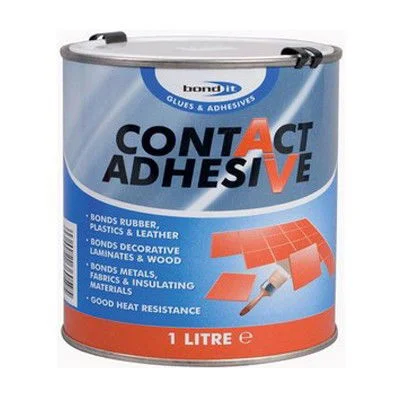
Bond It Contact Adhesive is a solvent-based neoprene formula with high grab and a long open time. Bonds rubber, plastics, leather, laminates, wood, metals and fabrics. 500ml tin, good heat resistance, suitable for a wide range of trade and workshop applications.
Bond It Contact Adhesive is a premium grade, solvent-based neoprene contact adhesive designed for bonding a wide variety of materials quickly and reliably. At 500ml, there is enough in a single tin to cover around 2.5 square metres using a notched trowel or brush, which puts it firmly in the range of a working tool rather than a trial size. High grab means you are not spending half the morning clamping things together.
Contact adhesive works differently from most other adhesives. You apply it to both surfaces, let it become touch dry, then bring the two faces together. The bond forms on contact, which is where the name comes from. Get the alignment right before you press, because there is very little forgiveness once the surfaces meet. That long open time is genuinely useful here — it gives you a reasonable window to position everything correctly before committing.
What Bond It Contact Adhesive Bonds
The list of compatible materials is one of the more practical things about this product. Rubber, plastics and leather bond well. So do decorative laminates and timber sheet materials, which makes it a go-to for kitchen worktop edges and similar joinery applications. Metals, fabrics and insulating materials are also on the list. The neoprene formulation provides good heat resistance once cured, which matters if the bonded assembly will be near a heat source or in a vehicle interior.
Coverage and Application
One litre covers approximately 2.5 square metres when applied with a notched trowel or brush. The 500ml tin therefore covers roughly 1.25 square metres in a single-coat application. This is a contact adhesive, so both surfaces need coating — factor that into your coverage calculations. Brush application works for smaller areas and awkward shapes; a notched trowel gives a more consistent coat on flat sheet material.
Solvent-based, so ventilate the work area. Flammable during application. Standard precautions apply, no surprises there.
Pro Tip: Apply a thin, even coat to both surfaces and wait until the adhesive is touch dry before joining — a thick, wet coat pressed together will slide and may peel later.
Bond It Contact Adhesive is used across a wide range of trades and workshops. Carpet and flooring fitters use it for bonding rubber-backed materials and sheet edging. Joiners and kitchen fitters rely on it for fixing decorative laminates to worktop substrates and applying solid timber edging strips. Upholsterers use it for foam, fabric and leather work. In vehicle and marine environments, it bonds headlining, insulation panels and trim to metal or composite surfaces where a permanent, heat-resistant bond is needed.
Best For
Decorative laminate bonding
Rubber, plastics and leather
Timber and sheet materials
Metals and fabrics
Insulating materials
Upholstery and trim work
Compatible Surfaces
Rubber
Plastics
Leather
Decorative laminates
Timber and MDF
Metals
Fabrics and foam
Key Properties
Solvent-based neoprene formula
High initial grab
Long open time
Good heat resistance when cured
Coverage approx. 2.5m² per litre
Brush or notched trowel application
Not suitable for: Not suitable for use on polystyrene foam or expanded foam materials, as the solvent content will dissolve them. Avoid use in unventilated spaces due to flammable solvent vapours.
Apply a thin, even coat of contact adhesive to both surfaces using a brush or notched trowel. Allow both coated surfaces to become touch dry before bringing them together. Drying time will vary depending on temperature, humidity and how thickly the adhesive was applied.
Once both surfaces are touch dry, carefully align them before contact. Press firmly across the entire bonded area to ensure full adhesion. The bond forms immediately on contact, so repositioning after joining is not possible. Apply firm, even pressure rather than localised force to avoid trapped air and weak spots.
Ensure both surfaces are clean, dry and free from dust, grease or loose material
Apply a thin, even coat of contact adhesive to both surfaces using a brush or notched trowel
Allow both coated surfaces to become touch dry — they should feel dry to the touch but remain slightly tacky
Check alignment carefully before joining, as repositioning after contact is not possible
Bring the surfaces together and press firmly, working from one edge to the other to avoid trapping air
Apply even pressure across the full bonded area and allow the bond to cure fully before placing the assembly under load
Do I need to apply contact adhesive to both surfaces?
Yes. Contact adhesive must be applied to both surfaces. The bond forms when two adhesive-coated faces are pressed together once touch dry. Applying to one surface only will not give a reliable bond.
Can Bond It Contact Adhesive be used on polystyrene or expanded foam?
No. This is a solvent-based product and the solvents will dissolve polystyrene and many expanded foam materials. Use a water-based contact adhesive for those substrates.
How much area will the 500ml tin cover?
Based on a coverage rate of approximately 2.5 square metres per litre, the 500ml tin will cover around 1.25 square metres. Remember that contact adhesive is applied to both surfaces, so account for double the total bonded area in your calculations.
Bond It Contact Adhesive is formulated using a neoprene polymer base in a solvent carrier, giving it strong initial tack and a workable open time. Neoprene-based adhesives are known for good resistance to heat, oil and moderate chemical exposure once fully cured. The solvent system enables fast film formation on porous and semi-porous substrates, supporting broad material compatibility across rubber, timber, laminates, leather and metals.

Reviews
There are no reviews yet.