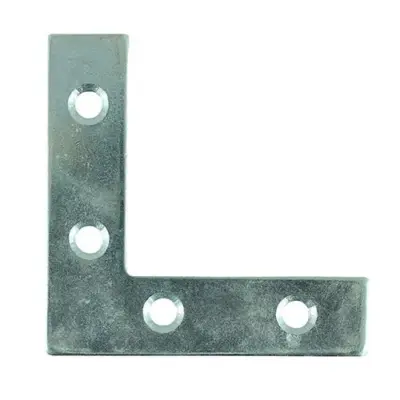
Zinc plated steel corner plates for strengthening and repairing timber joints. Countersunk holes allow a flush, clean finish. Supplied in a box of 50, available in two sizes: 50 x 50 x 13mm and 75 x 75 x 16mm.
Size
Price
QTY
50 x 50 x 13
£4.96£5.95
75 x 75 x 16
£8.96£10.75
Zinc corner plates are one of those unglamorous bits of metalwork that quietly hold a lot of construction together. Used to reinforce and repair timber joints at 90-degree angles, they are a staple for carpenters, joiners, general builders, and anyone working with stud walls, timber frames, shelving, or furniture repairs. The zinc plating gives them decent corrosion resistance for internal use, and the countersunk holes mean the screw heads sit flush rather than proud of the surface — which matters when you are fitting plasterboard over a studwork frame or finishing off a piece of joinery you actually want to look tidy.
These are available in two sizes: 50 x 50 x 13mm for lighter-duty or tighter applications, and 75 x 75 x 16mm where you need a bit more bearing surface and pull-out resistance. Both come in a box of 50, which is the kind of quantity that makes sense if you are framing a room, building out a stud partition, or just want a stock of them in the van without paying silly money per piece.
Where Zinc Corner Plates Get Used on Site
The 50mm size tends to get used on furniture repairs, internal joinery, stud framework, and anywhere the joint is not carrying a heavy structural load. The 75mm size suits heavier timber connections — think floor framing repairs, larger studwork, or situations where you want more mechanical grip across the joint. Neither size is intended for external use. Zinc plating handles indoor humidity well enough, but if you are building something exposed to weather, you want hot-dipped galvanised or stainless.
Countersunk Holes: A Small Detail That Actually Matters
It sounds basic, but countersunk fixing holes make a real difference in practice. A raised screw head on a corner plate that ends up behind a sheet of plasterboard is just waiting to cause a problem later. Flush fixings mean cleaner assembly, no unexpected bumps under sheet material, and a neater result on visible joinery work. The holes are pre-punched at spacing that suits standard wood screws, so no faffing about with a drill to open them up.
Supplied in a box of 50, these zinc corner plates represent solid everyday value for trade use, site stock, or keeping a sensible quantity on the shelf.
Pro Tip: Use the 75mm plates on any joint where the timber is taking a repeating load or vibration, such as a stud wall near a door opening, as the extra bearing area significantly reduces the chance of the fixing working loose over time.
Zinc corner plates are used wherever two pieces of timber meet at a right angle and need reinforcing or repairing. Common applications include stud partitioning, internal timber framing, shelving units, furniture construction and repair, workbench assembly, and general joinery work. Joiners, carpenters, general builders, and self-builders all keep a stock of these to hand. They are particularly useful during first-fix carpentry when speed matters and you want a reliable, flush-fitting fixing solution that does not slow down boarding.
Best For
Reinforcing 90-degree timber joints
Stud partition framing
Internal joinery and carpentry
Furniture repair and construction
Shelving and storage assembly
General timber repairs
Available In
50 x 50 x 13mm
75 x 75 x 16mm
Key Features
Zinc plated steel construction
Countersunk fixing holes for flush finish
Suitable for internal applications
Pre-punched holes for standard wood screws
Supplied 50 per box
Not suitable for: Not suitable for external or exposed applications. Zinc plating is intended for internal use only and will not hold up against prolonged moisture or weather exposure.
Mark the joint position and hold the corner plate centrally across the two timber faces. Use the countersunk holes to screw directly into the timber with suitable wood screws — the plate should sit flat and flush against the surface. No pre-drilling is required for most softwoods, though pilot holes will help in hardwood to avoid splitting.
Position the corner plate centrally across the timber joint at the 90-degree angle
Ensure the plate sits flat against both timber faces before fixing
Mark through the countersunk holes if locating accuracy is important
Drive wood screws through each hole, working from the centre out to avoid drawing the joint out of square
Check the joint is tight and square once all fixings are in place
Can these zinc corner plates be used outside?
No. Zinc plating provides adequate corrosion resistance for internal use but is not suitable for external or exposed applications. For outdoor timber joints, look for hot-dipped galvanised or stainless steel corner plates instead.
What screws should I use with these corner plates?
Standard countersunk wood screws work well. The fixing holes suit screws typically in the 3.5mm to 4mm diameter range. Screw length depends on your timber thickness, but a minimum of 25mm is a good starting point to get enough bite without punching through.
Manufactured from steel with a zinc plate finish, these corner plates provide mechanical reinforcement at timber-to-timber joints. The zinc coating offers corrosion resistance suitable for internal environments. Countersunk holes are pre-punched to accept standard wood screws and allow fixing heads to sit flush with the plate surface. Available in 50 x 50 x 13mm and 75 x 75 x 16mm profiles.
Material
Zinc plated steel
Finish
Zinc plated
Sizes Available
50 x 50 x 13mm, 75 x 75 x 16mm
Hole Type
Countersunk
Box Quantity
50
Application
Internal use only
Size
50 x 50 x 13, 75 x 75 x 16
Box Quantity
50
Reviews
There are no reviews yet.
Be the first to review “Corner Plates – Zinc – Box 50”Cancel Reply

Reviews
There are no reviews yet.